
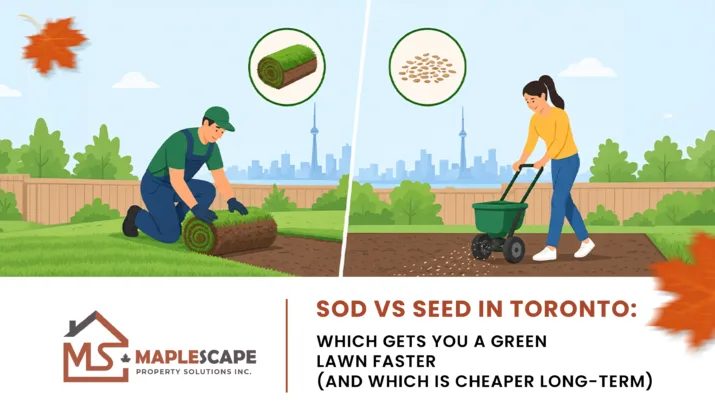
A tired lawn creates one practical question: should you lay sod or start again with seed?
The simple answer is that the sod is faster, and the seed is usually cheaper. The useful answer goes further. Toronto homeowners also need to consider establishment time, watering, weather, soil preparation, erosion, weeds, traffic, and what happens if part of the lawn fails.
If you are comparing Sod Installation Toronto with seeding, the right choice depends on whether your priority is speed or upfront budget.
1. Which Gets You a Green Lawn Faster: Sod or Seed?
Sod wins clearly on appearance.
Fresh rolls arrive with mature grass already growing, so the yard looks green as soon as installation is complete. That does not mean the lawn is instantly established. Roots still need time to knit into prepared soil, and new sods need careful watering during that period. Ontario sod guidance describes full establishment as taking several weeks under suitable conditions.
Seed takes longer because germination is only the beginning. Seedlings must emerge, thicken, fill bare spaces, and develop enough roots for regular mowing and traffic.
An Ontario sod producer estimates seeded lawns may need at least eight to twelve weeks to establish, while seed mix, temperature, moisture, and reseeding can extend that process. University turf guidance similarly identifies slower establishment as one of seeding’s main disadvantages compared with sod.
If you need a finished-looking lawn quickly, the sod has a stronger speed advantage.
2. Which Option Is Cheaper?
Seed wins on upfront material cost.
Current Canadian retail listings show lawn-seed products covering hundreds or thousands of square feet for tens of dollars, although price varies by mixture, package size, and included fertilizer or additives. University of Minnesota Extension also identifies seeding as the least expensive establishment method.
Sod costs more because you are buying mature turf that has already been grown, harvested, rolled, transported, and delivered as a perishable product. Sodding is generally the most expensive lawn establishment method.
However, comparing a seed bag directly with sod rolls misses the preparation underneath.
Both methods need suitable soil. If old turf must be removed, grading corrected, weeds addressed, or topsoil added, those costs remain whichever option you choose. Turf specialists recommend comparable site preparation before either seeding or sodding.
Seed can also involve:
- additional seed for thin or failed areas;
- frequent early watering;
- protection from traffic;
- weed management during establishment;
- extra time before normal use.
So, seeds are usually the cheaper starting point. It can also remain cheaper long-term when germination is successful, and significant reseeding is unnecessary.
Sod does not automatically become cheaper over time. Its value is different: faster coverage, shorter visual transition, and less uncertainty about initial density.
3. Does Toronto Weather Change the Sod-Vs-Seed Decision?
Yes. Timing can make either option easier or harder.
Toronto uses spring and falls for municipal sod and lawn-seeding restoration, specifically April to June and September to October. Those windows generally provide more favorable establishment conditions than peak summer heat.
3.1 Sod Covers Bare Soil Immediately
Sod creates surface coverage as soon as it is laid. That can matter on slopes or freshly prepared areas where rainfall could move loose soil before seedlings develop. University turf guidance specifically identifies erosion-prone sites as situations where sod’s immediate coverage can be useful.
Seed remains exposed while germinating. Heavy rain can shift seed or disturb the seedbed, while dry periods make consistent moisture especially important.
3.2 Seed Gives You More Choice
Seed lets you select mixtures for sun, shade, traffic, and other site conditions. Canadian retail mixtures commonly combine grasses such as fescue, bluegrass, and ryegrass in varying proportions, while university turf guidance identifies wider species and variety choice as an advantage of seeding.
Sod provides fewer mixture choices because the turf has already grown.
Neither method fixes a poor site itself. Persistent shade, compaction, drainage problems, or unsuitable soil should be considered before spending money on either.
4. What Does Each Lawn Need After Installation?
This is where the comparison becomes personal.
The new sod needs moisture immediately because its shallow root layer can dry quickly. Ontario sod guidance recommends prompt watering and checking moisture beneath the turf during establishment.
Seed needs consistent moisture near the soil surface while germinating. Letting that surface repeatedly dry can result in uneven establishments.
Sod:
- looks complete immediately;
- needs careful early watering;
- should have limited traffic while rooting;
- may need attention along edges and seams.
Seed:
- costs less initially;
- takes longer to fill in;
- can develop thin areas;
- may require patching or reseeding;
- needs patience before regular use.
The City of Toronto says established lawns generally need about 2.5 centimeters of water per week, including rainfall, with soil type affecting water frequency. That established lawn guidance should not be treated as a new-sod or germinating-seed schedule.
Once the lawn is established, lawn care and maintenance matters more than whether it originally arrived as rolls or seed.
5. Which One Makes More Sense for Your Toronto Yard?
A useful comparison starts with what you value most.
| Your Priority | Better Fit | Why |
| Green appearance immediately | Sod | Mature turf covers the yard on installation day |
| Lowest upfront material cost | Seed | Seed costs substantially less |
| Lawn needed soon | Sod | Visual coverage and establishment are faster |
| More grass-mixture choice | Seed | Blends can suit different site conditions |
| Slope or erosion concern | Sod | Immediate coverage protects prepared soil |
| Comfortable waiting | Seed | Patience supports the lower starting cost |
| Predictable initial density | Sod | Coverage is visible from day one |
For Sod Installation Toronto, sod makes the most sense when timing, appearance, surface coverage, or predictable density outweigh the lowest starting price.
Choose seed when budget matters most; the site can remain lightly used during establishment, and you are comfortable monitoring moisture and repairing thin patches if necessary.
That is the honest trade-off. Seed wins on cost. Sod wins on speed and immediate coverage.
6. Conclusion
If your main goal is the cheapest way to start a lawn, seed deserves the win. It costs less upfront and can produce an excellent lawn when preparation, weather, and care line up.
If your priority is speed, immediate coverage, or a more predictable finished appearance, Sod Installation Toronto offers advantages seed cannot provide on day one.
Compare the whole establishment process, not just rolling against a bag of seed. Soil preparation, watering, weather, erosion risk, repair work, and your available time all affect real value.
If the sod fits those priorities, Maple Scape can help assess the yard and plan an installation around the actual conditions of your Toronto or GTA property.
Is sod always better than grass seed in Toronto?
No. Sod is faster and provides immediate coverage, while seed costs less and offers more flexibility in grass mixtures. Budget, timeline, site conditions, and establishment effort should guide the choice.
Can I seed a lawn in summer?
You can, but hot weather makes moisture management harder. Toronto commonly uses spring and falls for municipal seeding and sod restoration, which are generally more favorable for establishment periods.
Does the sod still need soil preparation?
Yes. Sod needs good contact with prepared soil. Removing debris, correcting grades, loosening compacted ground, and creating an even surface can influence rooting and drainage.
How soon can I walk on a new sod?
Limit unnecessary traffic while roots are attached. Ontario supplier guidance recommends avoiding regular foot traffic during the early establishment period, particularly during the first one to two weeks. University guidance similarly recommends keeping traffic off until turf is well rooted.
What happens if grass seed grows unevenly?
Thin areas may need reseeding after you identify the cause. Uneven watering, seed movement, compaction, shade, weak soil contact, or unsuitable conditions can all contribute.