
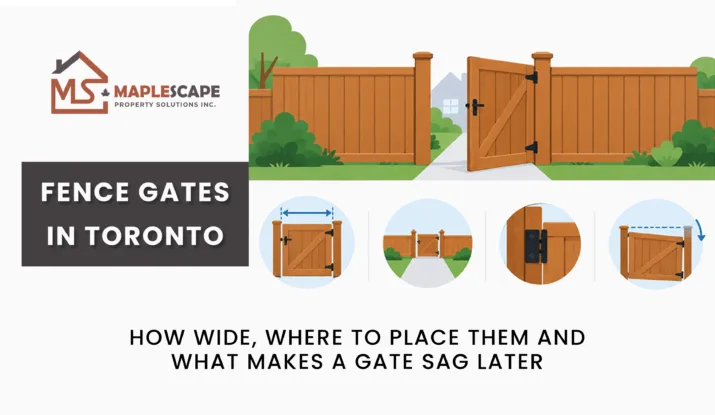
A fence can be perfectly straight and still be frustrating if the gate is too narrow, poorly placed, or dragging after winter.
That is why gate planning matters during fence installation toronto. The opening must match how the yard is used, while the hinge post, frame, hardware, grade, and swing direction need to work together.
Most gate problems are preventable. A few measurements and site checks before construction can make the difference between a gate that feels effortless and one that needs constant adjustment.
1. How Wide Should a Residential Fence Gate Be?
There is no single Toronto bylaw width for an ordinary residential pedestrian gate. Width should reflect access, the gate system, and what must pass through it. Toronto’s current fence rules focus instead on matters such as height, construction, driveway visibility, materials, and pool enclosures.
Manufacturers commonly offer walk gates around four to five feet wide. Fortress lists four-foot and five-foot walk gates, while Trex lists standard single-gate openings of roughly 46¼ inches and 65½ inches for one system.
Before choosing a width, measure what regularly needs access:
- garbage and recycling bins;
- lawn mower or snow blower;
- wheelbarrow;
- bicycles and strollers;
- patio furniture;
- landscaping equipment.
Allow comfortable clearance rather than designing to the exact equipment width.
For occasional vehicle or machinery access, a double gate may make more sense. Posts, hinges, latch, drop rod, and opening should be designed as one system.
2. Where Should a Fence Gate Be Placed?
A side-yard gate should connect naturally with the driveway, walkway, bins, backyard, or service path. If reaching it means squeezing beside equipment or walking around planting beds, the location will feel awkward.
2.1 Check the Swing Before Setting the Posts
Check whether the gate will hit steps, a downspout, parked vehicle, retaining wall, garden bed, or sloped ground. A gate that swings freely in August can drag after snow accumulates or seasonal movement reduces clearance.
If grade rises inside the swing arc, an inward-swinging gate may contact the ground before opening fully.
2.2 Driveway Sightlines Can Change the Design
Toronto Municipal Code Chapter 447 requires fences within 2.4 metres of a driveway to use open-fence construction for at least 2.4 metres from the lot line where the driveway begins. The goal is preserving views of the boulevard or highway.
Recent Toronto fence-exemption decisions show that this rule can apply to gates as well as fixed sections. A 2026 Scarborough decision, for example, specifically addressed pedestrian and driveway gates that did not meet open-construction requirements.
A solid privacy gate beside a driveway can therefore create a compliance problem even if the rest of the fence is acceptable.
3. Why Do Fence Gates Sag Even When the Panels Stay Straight?
A panel is supported between posts. A gate hangs from one side, so its weight creates leverage on hinges, fasteners, frame, and hinge post.
Common causes include:
- Hinge-post movement: the supporting post flexes or shifts.
- Frame racking: the gate frame distorts diagonally.
- Hardware movement: hinges or fasteners loosen or wear.
- Excessive weight: wider privacy gates place more demand on the hinge side.
- Ground movement: freeze-thaw conditions change alignment or clearance.
Trex reinforces the hinge-side post of its composite gate system with galvanized steel inserts and uses an anti-sag cable. That illustrates a broader principle: a moving gate generally needs more support than a fixed fence section.
4. How Should the Hinge Post and Foundation Be Designed?
The hinge post must resist gate weight, repeated opening, wind, and ground movement. A large privacy gate creates more leverage than a narrow open gate.
Master Halco notes that post installation should respond to soil and wind exposure, and that properly driven posts installed below the frost line can gain protection against frost heaves in freezing climates.
That does not create one universal Toronto post depth. Soil, post material, gate width, exposure, product instructions, and installation method all matter.
Ask a contractor:
- How will the hinge post differ from a normal line post?
- Does the gate system require reinforcement?
- How will the foundation account for soil and frost conditions?
- Is the hardware suited to the gate size and weight?
- What clearance is allowed for seasonal movement?
These questions reveal more than asking how many hinges will be installed.
5. What Changes if the Gate Is Part of a Pool Enclosure?
A pool gate is not a normal backyard gate with a lock added later.
Toronto requires a swimming pool enclosure to surround the pool completely, with openings limited to compliant gates. On a single residential property, the minimum enclosure height is 1.2 meters.
Pool gates must be supported on substantial hinges, self-closing, self-latching, and kept locked except while the pool area is in use. Toronto also regulates latch positioning and double-gate protection.
The city requires an approved Zoning Certificate and Pool Fence Enclosure Permit. The enclosure must be inspected before the pool can be filled or used.
Design a pool gate as a safety component from the beginning rather than upgrading a standard garden gate later.
6. What Should You Check Before Approving the Gate Layout?
Use one final pre-construction check.
| Decision | What to Confirm |
| Opening width | People, bins, and equipment fit |
| Location | It follows a logical route |
| Swing | No conflict with grade, steps, vehicles, or landscaping |
| Hinge post | Foundation suits gate weight |
| Hardware | Hinges and latch match the system |
| Driveway | Toronto sightline rules are checked |
| Pool | Chapter 447 requirements are satisfied |
| Utilities | Locates are complete before excavation |
Ontario One Call says fence construction requires location before excavation. When a contractor is digging, the contractor is responsible for obtaining them. Homeowners are still advised to make sure the contractor has completed the locate process before work begins.
7. Conclusion
A good gate should feel almost forgettable once built. It should open fully, clear the ground, line up with the latch, and fit the people and equipment using it.
For fence installation Toronto, start with function before choosing a standard width. Map the route, measure equipment, check the swing arc, respect driveway sightlines, and give the hinge post the structural attention a moving gate deserves.
If an existing gate sags, fence repair Toronto may be enough when the surrounding fence remains sound.
Maple Scape can help Toronto and GTA homeowners plan gates around access, site conditions, and the fence system so the finished entrance works naturally with the yard.
Frequently Asked Questions
Is a four-foot gate wide enough for a Toronto backyard?
Often, yes for pedestrians and many lawn tools. Measure bins, mower, wheelbarrow, furniture, and other equipment before deciding. Product systems also have specific gate sizes.
Should a backyard gate swing inward or outward?
There is no universal answer. Choose the direction that provides safe clearance and avoids conflict with grade, steps, vehicles, landscaping, or the route people use.
Why does my gate drag after winter?
The hinge post may have shifted, hardware may have loosened, the frame may have racked, or ground movement may have reduced clearance. Diagnose the post and frame before moving the latch.
Can I install a solid gate beside my driveway?
Not automatically. Toronto requires open-fence construction within 2.4 metres of a driveway for the specified distance from the lot line, and gates can fall within this rule.
Do I need utility locates for new gate posts?
Yes when excavation is required. Ontario One Call identifies fence construction as digging work requiring locates before work begins.