
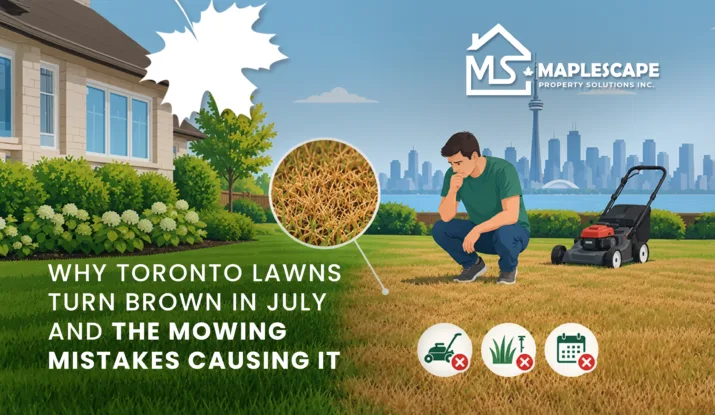
A Toronto lawn can look healthy in June and suddenly turn straw-colored in July. It is tempting to blame “not enough water,” but summer browning has several possible causes, and they do not all need the same fix.
Good lawn maintenance Toronto starts with diagnosis. The grass may be entering normal drought dormancy, reacting to mowing stress, losing roots to grubs, or showing chinch bug damage. Watering every brown patch harder can waste water while hiding the real pattern.
The better question is simple: what is the lawn telling you?
1. Is Your Lawn Dormant, Damaged, or Dying?
Cool-season turf naturally slows during hot, dry weather. Ontario notes that Kentucky bluegrass needs about 2.5 centimeters of water weekly to prevent dormancy, while Toronto gives approximately the same weekly target for established lawns, including rainfall.
Dormancy is a survival response. Blades lose color and growth slows, but the crown and roots may remain alive. With cooler weather and moisture, dormant turf can green again.
Start with the pattern.
| Condition | What You May See | First Check |
| Drought dormancy | Broad straw-brown areas | Soil moisture and recent rainfall |
| Scalping | Brown strips after mowing | Mower path and cutting height |
| Chinch bugs | Expanding patches in sunny turf | Thatch and soil surface at patch edges |
| White grubs | Wilted or dead patches | Root strength beneath the turf |
Ontario warns that insect damage can be masked while turf is dormant. Insect-damaged grass may stay brown after nearby drought-stressed turf begins recovering.
2. Could July Heat Simply Be Sending the Lawn Dormant?
absolutely.
Toronto advises mowing less during summer and dry spells. The city recommends morning watering, a rain gauge, and roughly 2.5 centimeters of water weekly for established lawns while accounting for rainfall and soil type.
Before deciding the lawn needs rescue, ask:
- Has rainfall been limited recently?
- Is browning broad rather than sharply localized?
- Has growth slowed across most of the lawn?
- Does the turf still feel firmly rooted?
- Are shaded or lower areas greener?
Those clues lean toward moisture stress or dormancy.
If you choose to keep turf actively green, irrigation needs to support that growth consistently. If you allow it to become dormant, avoid unnecessary mowing and heavy traffic while it is stressed.
For a useful photo check, photograph the same section before and several days after meaningful rain. Broad greening suggests drought stress. Patches that remain brown deserve closer inspection.
3. Which Mowing Mistakes Make July Browning Worse?
3.1 Cutting Too Short
Toronto recommends keeping turf around 6 to 7.5 centimeters. Higher mowing supports stronger roots and helps the lawn retain water and nutrients.
Scalping removes too much leaf tissue when the turf is already dealing with heat. On uneven ground, the mower deck can also shave high spots, leaving brown patches that match the terrain.
If color changes immediately after mowing, check cutting height before blaming insects or disease.
3.2 Cutting Because the Calendar Says So
Grass grows more slowly during summer dryness. A weekly schedule should not force a cut when there is little growth. Toronto specifically recommends mowing less during dry spells and summer.
If the lawn has barely changed its height, leave it alone. Repeated mower traffic across stressed turf adds pressure without providing much benefit.
Dull blades matter too. Toronto recommends sharpening mower blades because dull edges tear grass rather than cutting cleanly. Ragged tips can make an already stressed lawn look even browner.
Good lawn care and maintenance in July often means doing less but doing it carefully.
4. How Can You Tell Chinch Bug Damage from Drought?
Penn State Extension reports that chinch bug problems commonly appear during hot, dry weather in sunny turf, particularly where thatch is present. Brown areas can expand and merge. Ontario also warns that hairy chinch bug injury may be masked by drought dormancy.
Look at patterns and persistence.
Inspect the boundary between healthy and brown turf rather than only the dead center. Part the grass and look near the thatch and soil surface.
Do not diagnose chinch bugs from color alone. A dry sprinkler zone, compacted soil, a sunny slope, shallow soil, or grass beside heat-reflecting pavement can look similar. Toronto notes that compacted soil can reduce water infiltration, while insect and drought symptoms can overlap.
For lawn maintenance in Toronto, mark the edge of a suspicious patch or photograph it from above. If the patch keeps expanding while surrounding turf stabilizes, investigate before treating.
Ontario restricts cosmetic pesticide use on lawns, so identification should come before any control of product.
5. What Does Grub Damage Look Like, and Is July Too Early?
White grubs feed grass roots, but July is not usually when new-generation grub injury is most obvious.
Ontario’s Japanese beetle guidance says affected turf typically begins wilting and yellowing during August and September. As root feeding progresses, dead patches can lift or roll back because roots have been eaten.
A lawn turning broadly brown during an early July heat wave points more strongly toward drought stress, mowing injury, or surface-feeding insects than classic late-summer grub injury. Penn State similarly places obvious white-grub damage more commonly in spring and late summer into fall.
Gently tug affected the turf. Healthy grass should be resisted. Turf that lifts unusually easily should be inspected underneath for root loss and C-shaped white larvae.
Wildlife digging may provide another clue because animals can forage grubs near the surface, but digging alone is not proof.
6. Conclusion
A brown July lawn is not automatically a dead lawn, and it is not automatically a grub problem.
Start with rainfall, soil moisture, cutting height, mower condition, sprinkler coverage, rooting, and the shape of the brown area. Then watch what happens after cooler weather or useful rain. Dormant turf may recover. Pest-damaged or badly injured areas may not be affected.
Good lawn maintenance Toronto includes knowing when not to react too quickly.
For this topic, original GTA photographs add real diagnostic value. A wide photo can show drought patterns, while close-ups can document scalping, patch edges, chinch bug scouting, or turf lifting where grubs are suspected.
If the pattern still does not make sense, Maple Scape can help assess the lawn before you spend time or money treating the wrong problem.
Frequently Asked Questions
Why did my Toronto lawn turn brown so quickly in July?
Heat, low rainfall, short mowing, uneven irrigation, chinch bugs, and other stresses can all change turf color quickly. Start with the pattern, soil moisture, mowing history, and rooting before choosing a treatment.
Should I water brown grass every day?
Usually not. Toronto recommends deeper, less frequent watering for established lawns and about 2.5 centimeters weekly, including rainfall. The new sod needs different care. Check actual soil moisture rather than watering automatically.
Will dormant grass become green again?
Often, yes, if crowns and roots remain alive. Cool-season turf can lose color during drought and resume growth after moisture and cooler temperatures return. Patches that remain dead may have another cause.
How can I tell if my mower scalped the lawn?
Look for browning that appears directly after mowing, particularly on high spots, uneven ground, or repeated mower paths. Check the finished height against Toronto’s recommended 6 to 7.5 centimeters.
Should I treat brown patches to insects immediately?
No. Confirm that insects are actually present first. Ontario limits cosmetic pesticide uses on lawns, so any treatment decision should follow accurate identification and current provincial rules.