
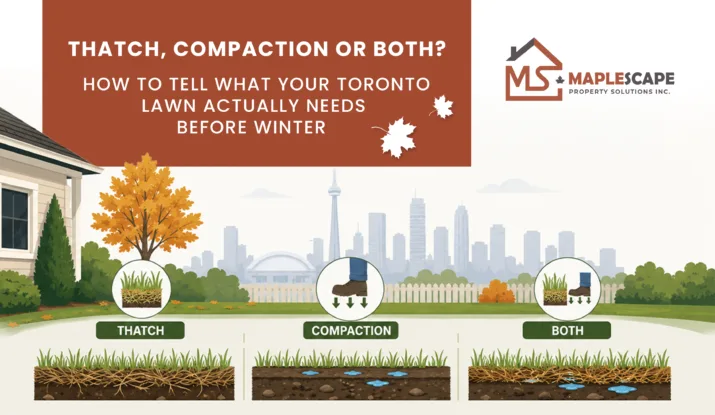
Before winter, Toronto homeowners should diagnose the lawn before booking treatment. Good lawn care and maintenance starts by separating excess thatch from compacted soil because they need different responses. A thin organic layer can protect turf, while hard soil can restrict water and air movement.
Table of Contents
- Introduction
- Start With the Right Diagnosis
- How to Tell If Thatch Is the Real Problem
- How to Recognize Compacted Soil
- Aeration or Dethatching: Which Treatment Fits?
- What If Your Lawn Has Both Problems?
- What Should You Do Before Winter?
- Conclusion
- Frequently Asked Questions
1. Introduction
A lawn can feel spongy, drain slowly, thin near a walkway, or simply stop responding the way it used to.
Thatch develops between green grass and soil. Compaction happens when soil particles are pressed together, reducing pore space around roots. Penn State links aeration with relieving compaction, while Iowa State notes that excessive thatch can interfere with turf health.
That matters before you choose treatment.
2. Lawn Care and Maintenance Starts With the Right Diagnosis
It is easy to see weak grass and assume the lawn needs aeration or dethatching. A better first step is to inspect the profile.
Cut a wedge where symptoms are obvious. Look between the green vegetation and mineral soil. The brown, springy material between them is the thatch layer.
Iowa State says a modest layer up to about half an inch can be beneficial, while amounts greater than that are generally considered excessive. Penn State recommends mechanical removal when buildup reaches about one inch.
2.1 A Little Thatch Is Normal
Thatch is made mainly from slowly decomposing stems, crowns and roots. Grass clippings are not usually the main cause because they break down relatively quickly.
A modest layer can cushion the surface and moderate temperature. Trouble begins when organic material accumulates faster than it decomposes.
2.2 When Thatch Becomes a Problem
As buildup thickens, turfgrass roots may begin growing in the organic layer rather than deeper soil. That can make turf more vulnerable when the layer dries.
So, if someone recommends dethatching Toronto lawns simply because brown material exists below the grass, ask how thick it actually is.
3. How to Tell If Thatch Is the Real Problem
Thatch is confirmed by looking below the grass, not by judging color from a distance.
Watch for a noticeably springy surface and a visible brown band between vegetation and soil. Take small cross-sections from several areas because buildup can vary across the property.
3.1 The Half Inch and One-Inch Numbers Need Context
Iowa State treats more than one-half inches as generally detrimental. Penn State recommends dethatching at about one inch or more. Think of these different points on a spectrum: half an inch deserves attention; one inch makes mechanical removal much easier to justify.
That nuance matters because aggressive power raking can disturb healthy turf unnecessarily.
4. How to Recognize Compacted Soil
Heavy foot traffic, pets, equipment and activity on wet ground can press particles closer together. Penn State identifies traffic as a common cause, while the City of Toronto notes that soil may be compacted when it stops absorbing water effectively.
This is where lawn care and maintenance shift from surface inspection to a simple soil check.
4.1 Try the Moist-Soil Screwdriver Test
Illinois Extension suggests pushing a screwdriver into moist soil in several locations. If it is difficult to insert, compaction is likely and aeration may help. It is not a laboratory measurement, but it is a useful homeowner screening test.
Other clues include poor water infiltration, hard ground, and thin grass along traffic routes.
4.2 Why Core Aeration Targets Compaction
True core aeration uses hollow tines to remove plugs. Iowa State warns that spike tools can press soil rather than relieve the problem.
The removed soil cores create temporary channels for air, moisture, and nutrients through the root zone.
5. Aeration or Dethatching: Which Treatment Fits?
The phrase “lawn aeration vs dethatching” sounds like an either-or decision, but diagnosis should be decided.
Choosing aeration when compacted soil is the main problem. Consider dethatching when the organic layer is genuinely excessive. Core aeration can also help manage moderate buildup because bringing soil organisms upward supports decomposition. Penn State identifies increased microbial activity as one reason aeration helps thatch management.
5.1 A Quick Decision Guide
- Spongy surface plus a thick measured organic band: investigate dethatching.
- Hard soil plus poor penetration when moist: investigate aeration.
- Heavy traffic plus excessive measured thatch: both may be justified.
- Thin lawn without either condition: look for another cause before treating.
6. What If Your Lawn Has Both Problems?
Compaction can slow drainage and biological activity, while excessive organic buildup can further interfere with movement into the soil. Purdue notes that compaction itself can contribute to thatch accumulation.
When both are confirmed, treatment should reflect lawn conditions. Core aeration is less destructive than aggressive dethatching and can help compaction while gradually reducing buildup. Severe thatch may still require mechanical removal.
If you are comparing lawn care services Toronto, ask one useful question: what evidence shows my lawn needs this treatment?
7. What Should You Do Before Winter?
Penn State recommends aeration during cool-weather active growth and cautions against dethatching in late fall because turf may not recover adequately before winter stress. Illinois Extension also recommends dethatching cool-season lawns while recovery conditions remain favorable.
So here is the practical Toronto takeaway: do not wait until the lawn is approaching winter dormancy and then perform an aggressive treatment simply because fall cleanup is underway.
8. Conclusion
The smartest lawn care and maintenance decision before winter is not choosing between two machines. It is figuring out what is happening beneath your feet.
Measure thatch. Check moist soil resistance, traffic patterns, and drainage. Aerate compact soil. Dethatch excessive buildup. If both are present, a staged approach may make more sense.
Maple scape Property Solutions provides lawn care, mowing, landscaping and seasonal maintenance across Toronto and the GTA. A condition-based assessment can help determine what needs attention now and what is better left for another season.
Frequently Asked Questions
How Do I Know If My Lawn Has Too Much Thatch?
Cut a small lawn section and measure the brown organic layer between grass and soil. More than about half an inch deserves attention; around one inch creates a stronger case for removal.
Can Aeration Remove Thatch?
Aeration can reduce and prevent moderate buildup over time, but it is not designed to remove a severe layer quickly. Heavy thatch may require mechanical removal.
Is a Spongy Lawn Always Caused by Thatch?
No. Confirm by cutting a small cross-section. Surface softness alone is not enough to diagnose the problem.
Should I Dethatch My Lawn Every Fall?
No. Penn State says annual dethatching is unnecessary. Treat excessive buildup only when it is actually present.
Is Fall a Good Time to Aerate in Toronto?
Yes, when cool-season grass is actively growing and soil is slightly moist. The City of Toronto identifies spring and fall as suitable periods.