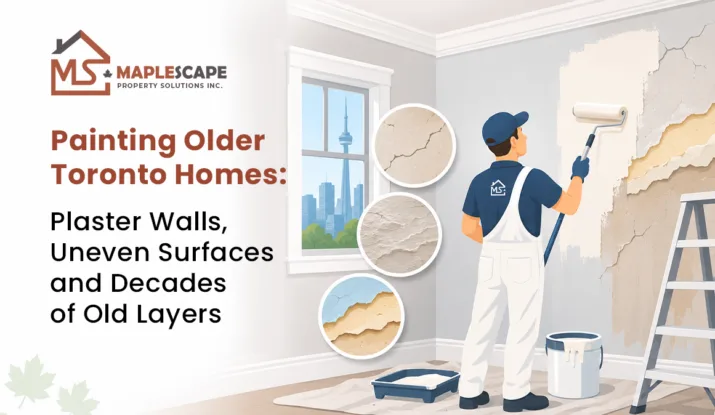
Older Toronto homes often need more preparation than newer drywall interiors. Good home painting services should identify whether plaster is sound; cracks are cosmetic or active, and old coatings may contain lead. The goal is a stable, clean, compatible surface that can hold a new finish safely.
Table of Contents
- Introduction
- Home Painting Services for Older Toronto Walls Start with Diagnosis
- Plaster Walls Are Not the Same as Drywall
- Uneven Surfaces: Repair, Skim or Leave the Character?
- Decades of Old Paint Change the Prep Strategy
- Primer and Finish Choices Matter More on Old Walls
- What a Professional Painting Assessment Should Cover
- Conclusion
- Frequently Asked Questions
1. Introduction
Walk into an older Toronto house, and the walls often tell a story.
You may see cracks above doors, waves in plaster under side light, old patches, or trim carrying layers of previous finishes. None automatically means the wall needs replacement.
Hairline cracks can often be repaired when surrounding plaster remains sound, while cracks linked to structural movement should be investigated first.
So, the first job is not choosing paint. It is understanding the surface.
2. Home Painting Services for Older Toronto Walls Start with Diagnosis
A painter should answer three questions.
Is the plaster firmly attached? Is moisture causing deterioration? Are existing coatings stable enough for another finish?
A topcoat cannot compensate for weak layers.
2.1 Hairline Cracks and Moving Cracks Are Different
Hairline plaster cracks are often cosmetic when the surrounding material remains sound.
A crack that widens, repeatedly reopens, or appears with sagging deserves more investigation. Painting over movement only hides the symptoms. The National Park Service recommends addressing structural causes before repairing cracks created by significant movement.
2.2 Moisture Has to Be Solved First
Plasters can deteriorate when roofs, plumbing, masonry, or drainage allow repeated moisture into the wall.
If staining, bubbling, softness or recurring peeling appears, find the moisture source before repainting. Repairing a wet substrate without solving the cause can fail again. Preservation guidance specifically warns that repairs made over a wet base are likely to fail.
3. Plaster Walls Are Not the Same as Drywall
Modern drywall uses boards with taped joints. Traditional plaster was commonly built in multiple coats over lath, masonry or another base.
That difference changes repair decisions.
3.1 Sound Plaster Is Often Worth Keeping
Slight waves, old trowel marks and subtle variation can be part of an older home’s character.
Preservation guidance generally favours retaining sound historic plaster rather than removing it because it is cosmetically imperfect.
For interior painting Toronto, ask: do you want a cleaner painted surface, or a wall that looks like a new drywall?
Different scopes.
3.2 Loose Plaster Needs More Than Filler
If plaster has separated from the lath or substrate, filling the visible crack alone does not stabilize it.
Areas that sound hollow, bulge, sag or move may require plaster repair. Structural concerns need an appropriate specialist.
4. Uneven Surfaces: Repair, Skim or Leave the Character?
Old walls can show patch edges, shallow depressions, and surface waves. Strong side lighting makes variation more visible.
A painter should not automatically skim every wall.
4.1 Patch Local Defects When the Wall Is Basically Sound
Small holes and isolated imperfections can often be patched, feathered, and primed locally.
Repairs should blend with surrounding texture, so the finish does not trade one visible defect for another.
4.2 Skim Coating Is for Greater Uniformity
A skim coat creates a more consistent plane across widespread imperfections but adds labour and drying time.
If the original plaster character is attractive, full flattening may not be desirable.
Good home painting services should explain trade-off before pricing.
5. Decades of Old Paint Change the Prep Strategy
Health Canada says homes built before 1960 probably contain lead-based paint. Homes built between 1960 and 1990 may also contain lead, including lower levels in some interior coatings. Houses built after 1990 should be virtually lead-free from consumer paint.
That means an old wall should not automatically be attacked with a power sander.
5.1 Test Before Disturbing Questionable Old Coatings
If lead may be present, Health Canada recommends testing and warns against sanding, scraping, heat guns or burning methods that can create hazardous dust or fumes.
Intact lead-based paint may sometimes be safer left undisturbed and covered with a compatible coating.
This is a health decision, not cosmetic prep.
5.2 Adhesion Still Needs to Be Checked
Even without lead, decades of coatings can create compatibility problems.
Previously painted surfaces should be clean, dry and free from loose material. Sherwin-Williams recommends painting a small inconspicuous test area when adhesion is uncertain.
That test can reveal lifting or poor bonding before the whole room is coated.
6. Primer and Finish Choices Matter More on Old Walls
Primer is not one universal product used because a wall is old. The system depends on the surface.
Powdery plaster, repaired areas, stains, bare patches and glossy coatings may need different preparation or primers. Sherwin-Williams similarly advises that old coatings be cleaned and firmly adhering before repainting.
6.1 Clean and Stable Comes Before Primer
Dust, grease, residue, and loose paint interfere with adhesion. Coated walls should be cleaned and allowed to dry before primer or a test coat.
For interior painting services, much of the value is in this invisible preparation.
The color gets noticed. Preparation helps it stay there.
7. What a Professional Painting Assessment Should Cover
Before quoting an older Toronto interior, inspect:
- plaster cracks, movement and hollow areas
- moisture or previous water damage
- loose, peeling or chalking coatings
- possible lead-paint risk based on age
- previous patches and uneven textures
- trim and high-contact painted surfaces
- desired finish quality and tolerance for historic variation
This prevents a common mismatch: agreeing on colour without agreeing on how smooth the walls should become.
8. Conclusion
Older homes do not need to be treated like defective new homes.
Good home painting services start by deciding what should be repaired, preserved, and left undisturbed until tested.
Sound plasters can often stay. Hairline cracks can often be repaired. Unevenness can be improved selectively. Old coatings need adhesion checks, and possible lead paint needs safer handling before preparation begins.
Maple scape Property Solutions provides interior painting and related property maintenance across Toronto and the GTA. With older walls, the strongest result usually comes from understanding the surface before deciding how to finish it.
Frequently Asked Questions
Can You Paint Directly Over Old Plaster Walls?
Yes, when the plaster and coating are sound, clean, dry, and compatible. Cracks, powdery areas, moisture damage, and loose coatings should be addressed first.
Do Hairline Cracks Mean Plaster Has Failed?
Not necessarily. Hairline cracks can be cosmetic when surrounding plaster remains attached. Cracks that widen, move repeatedly or accompany bulging need assessment.
Should Old Toronto Walls Be Sanded Before Painting?
Not automatically. If coatings may contain lead, Health Canada warns against sanding that creates contaminated dust. Test questionable paint before disturbing it.
Is Skim Coating Necessary on Every Uneven Wall?
No. Skim coating suits widespread imperfections when a smoother finish is desired. Local defects may need only targeted repair.
Is Primer Always Required on Previously Painted Walls?
Not in the same way for every wall. Bare repairs, stains, porous plaster, glossy finishes or problem coatings may need specific primers. Surface condition should determine the system.