
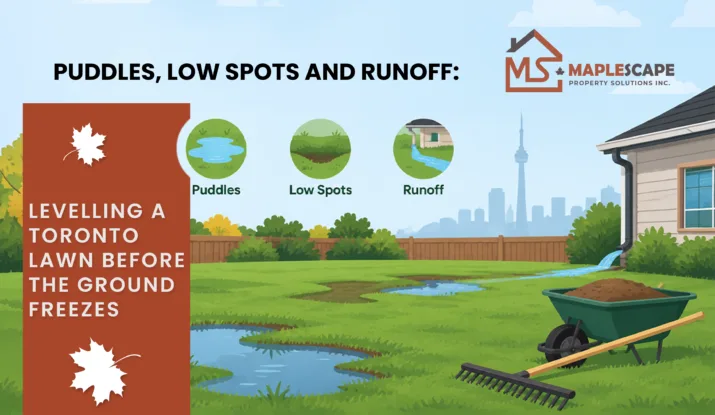
Autumn rain shows you where a lawn holds water. For Toronto homeowners, grass and landscaping work should start by identifying whether the problem is a shallow depression, compacted soil, or broader grading. Minor low areas may be corrected with soil and turf repair, but water moving toward a foundation needs a drainage plan.
Table of Contents
- Introduction
- Grass and Landscaping Starts with Where Water Goes
- Low Spot, Compaction or Grading Problem?
- How Much Slope Should a Toronto Lawn Have?
- How to Level a Small Lawn Depression
- When Seed, Sod or Topsoil Makes Sense
- When a Drainage Problem Needs Professional Help
- Conclusion
- Frequently Asked Questions
1. Introduction
One puddle may mean little. A puddle returning after every autumn rain deserves investigation.
Water follows elevation. Settlement can pull runoff into a depression, while compacted soil can hold water even when the grade looks reasonable. If the whole yard pitches toward the house, adding soil to one patch will not solve the problem.
Fall helps because rainwater is visible while soil remains workable.
2. Grass and Landscaping Starts with Where Water Goes
Before adding soil, seed, or sod, watch where water travels after steady rain.
Toronto says landscaping should slope away from foundation walls and identifies poor lot grading or drainage as a possible route for water entering a home. Water should not be redirected onto neighboring property.
2.1 Map the Wet Areas Before You Repair Them
Mark each low spot and note whether water arrives from a downspout, patio, driveway, neighbour, or higher lawn.
Then ask whether water is collected because the ground is low or because it cannot enter the soil. That distinction changes repair.
2.2 Check Downspouts Before Regrading
Toronto requires disconnected downspouts to direct water away from buildings without damaging neighbouring property, driveways, or sidewalks.
You know what often happens? A downspout empties into a depression, and added soil treats the puddle while leaving the source untouched.
3. Low Spot, Compaction or Grading Problem?
Three problems can create similar puddles.
A local depression is usually obvious after rain. With soil compaction, the grade may be fine, but dense soil slows water infiltration. Illinois Extension notes that isolated low areas or compaction may respond to filling or core aeration, while severe drainage problems may need regrading or subsurface drainage.
A broader grading problem appears when water repeatedly crosses a larger area toward the same destination.
3.1 Do Not Level a Lawn by Eye Alone
A lawn can look flat yet still drain or look sloped while hiding a pocket that traps runoff.
Use a long board and level, string line, or grade-measuring equipment to compare elevations. Larger corrections near buildings should not be guessed.
4. How Much Slope Should a Toronto Lawn Have?
Toronto’s grading requirements for new infill housing call for side-yard surface drainage slopes of at least 1.5 percent toward a positive outlet. Ontario’s stormwater manual says grading within roughly 2 to 4 meters of a building should generally be 2 percent or greater, subject to municipal standards.
A 2 percent slope means about 2 centimeters of drop over every 1 meter. A 1.5 percent slope equals about 1.5 centimeters per meter.
These are reference measurements, not a rule for every existing lot. For grass and landscaping, the goal is positive drainage without creating another problem.
5. How to Level a Small Lawn Depression
A shallow depression may be straightforward enough.
5.1 Build the Grade, Not Just the Surface
The repair material needs to restore the intended contour. Landscape Ontario’s turf standard says grading should eliminate low areas, create positive drainage, and place growing medium over a prepared subgrade. It also specifies that topsoil should be placed in dry weather on unfrozen ground.
That matters in fall because frozen soil is unsuitable for proper shaping.
For modest unevenness, topsoil can rebuild the surface before turf is restored. Deep depressions, repeated settlement, or unexplained sinking need investigation rather than repeated topping up.
5.2 Recheck the Result With Water
After shaping, do not judge success only by appearance.
Check the elevation again and observe the next rainfall. Good grading should change the path water takes, not simply hide the puddle beneath fresh soil.
6. When Seed, Sod or Topsoil Makes Sense
After correcting the contour, the turf must recover.
Landscape Ontario recommends fall seeding from roughly mid-August through September. Sods should be installed during active growth, not at freezing temperatures or over frozen soil.
6.1 Overseeding Works Best When Existing Turf Remains
If levelling only disturbs a thin section, seed may integrate with surrounding grass while conditions still support turf establishment.
6.2 Sod Makes Sense When the Surface Needs Full Replacement
If the area has been excavated, extensively regraded, or has little usable turf left, Sod Installation Toronto may provide faster complete coverage once the soil profile is correct.
But do not use sod to disguise unresolved drainage. New turf over the same depression will eventually show the same water pattern.
7. When a Drainage Problem Needs Professional Help
Some wet spots are lawn repairs. Others are drainage problems.
Professional assessment matters when water runs toward the foundation, crosses property boundaries, repeatedly floods a large area, follows an altered swale, or connects with hard surfaces.
Toronto’s infill guidance says drainage patterns should be maintained, ponding and erosion should not be created, and stormwater should not adversely affect adjacent properties.
That is where outdoor property maintenance moves beyond routine lawn work.
A contractor may need to evaluate elevations, a drainage swale, downspout discharge, soil condition, and hardscape before recommending added soil, excavation, or another drainage measure.
8. Conclusion
Autumn puddles reveal where a lawn loses elevation, where soil resists water, and where runoff travels incorrectly.
Good grass and landscaping starts by identifying the real problem. Correct small depressions while soil is workable, restore turf when conditions allow, and treat foundation-directed water as grading rather than cosmetics.
Maple scape Property Solutions provides topsoil installation, lawn care, landscaping, and property maintenance services across Toronto and the GTA.
Frequently Asked Questions
Can I Fill a Lawn Puddle With Topsoil?
Yes, if the puddle comes from a shallow isolated depression and the new contour maintains proper drainage. Repeated or deep ponding should be diagnosed first.
What Is a 2 Percent Lawn Slope?
It is approximately a 2-centimetre vertical drop for every 1 metre of horizontal run.
Can Compacted Soil Cause Standing Water?
Yes. Dense soil can slow infiltration even when the surface grade appears reasonable. Core aeration may help where compaction is the main cause.
Is Fall a Good Time to Level a Toronto Lawn?
It can be, provided the soil is workable rather than saturated or frozen and there is enough growing time left to restore disturbed turf.
Should Water Ever Be Graded Toward a Neighbour’s Yard?
No. Toronto guidance says grading and drainage should not negatively affect adjacent properties. Larger changes near property boundaries should be planned carefully.