
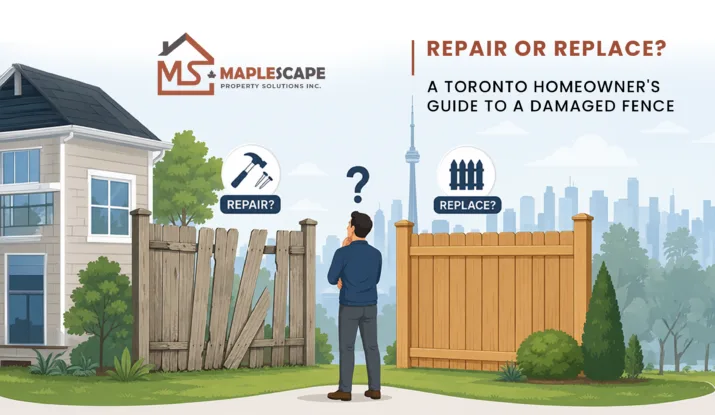
A damaged fence can look worse than it really is. One leaning post can pull good panels out of line, while a sagging gate can make an otherwise solid fence feel tired.
The useful question is whether the damage is local, structural, repeatable, or spreading.
For homeowners comparing fence repair Toronto, the good news is that many fences do not need to come down completely. A careful inspection can separate a manageable repair from a replacement project before you spend money on the wrong solution.
1. Should You Repair or Replace the Fence?
Start by walking the entire fence line rather than judging the worst-looking section.
Use this quick decision guide:
| What You Find | Repair Usually Makes Sense | Replacement Deserves a Quote |
| One loose or damaged board | Yes | Rarely |
| One sagging gate | Often | If posts and frame are failing too |
| One or two weak posts | Often | If many posts are loose or rotten |
| Local storm damage | Often | If damage runs through several sections |
| Widespread rot or decay | Less likely | Usually |
| Repeated leaning after repairs | Investigate | Often |
| Multiple failing panels and posts | Less likely | Often |
Toronto requires fences to be maintained in good repair, structurally sound condition, and free from hazards.
Condition matters more than age alone. A ten-year-old fence with one failed post may be a better repair candidate than a younger fence with widespread damage and unstable posts.
2. What Fence Problems Can Usually Be Repaired?
Localized damage is where repair earns its value.
A loose board, broken picket, damaged lattice, misaligned latch, or isolated rail can often be replaced without disturbing the rest of the fence. Storm damage may also be repairable when the surrounding structure remains firm.
2.1 Look Closely at the Posts
Posts carry the fence, so inspect them carefully.
Push gently against several sections. A panel moving because one post is loose is different from a whole run shifting together.
Look near ground level for softness, cracking, decay, footing movement, or washed-out soil. If one post is compromised and neighboring sections remain sound, replacing or stabilizing it may preserve much of the fence.
If every second post is moving, the calculation changes quickly.
Neighboring sections can also share loads, so replacing one weak component without checking adjacent connections may leave the original movement unresolved.
2.2 Check Gates Separately
A gate can sag because of hinge wear, loose hardware, a shifting post, or a frame that is no longer square.
Do not assume the entire fence needs replacement because the gate drags. First determine whether the problem sits in the hardware, frame, supporting post, or surrounding fence.
That diagnosis can turn an intimidating project into a focused repair.
3. When Does Full Replacement Start Making More Sense?
Replacement becomes easier to justify when failures are no longer isolated.
If several posts are unstable, rails are deteriorating, panels repeatedly come loose, and previous repairs overlap, another patch may only postpone the larger job.
Widespread failure also matters when the fence no longer performs its main purpose. Privacy gaps, unreliable gates, unstable sections beside walkways, or leaning panels near neighbors can make piecemeal repairs less satisfying.
Appearance alone is not always enough reason to replace it. Faded wood can sometimes be cleaned, repaired, or refinished if the structure is healthy.
A fence that looks acceptable can still need major work if posts are decaying near grade.
Combine structural condition, repair history, safety, function, and cost rather than age alone.
4. What Is the Cost Crossover Between Repair and Replacement?
Current Homestar’s Toronto listings put many fence repairs around $200 to $1,000, while its 2026 Toronto cost guide places new installed fencing broadly around $40 to $150 per linear foot depending on material, height, and site conditions.
Those ranges are budgeting references, not a quote.
A practical homeowner checkpoint is to compare the repair estimate with replacing the same affected fence run.
If repair approaches roughly half the replacement price while leaving several old posts, rails, or panels likely to need attention soon, replacement deserves serious consideration. This is a budgeting heuristic, not an industry law, inferred from current repair and replacement ranges plus remaining fence condition.
Do not compare a $900 repair with replacing an entire property perimeter if only one 20-foot section fails. Compare like with like.
Also ask whether replacement pricing includes demolition, disposal, gates, delivery, posts, concrete, and difficult access. Homestar’s notes that removal may be included or quoted separately.
5. What Toronto-Specific Checks Matter Before Replacing a Fence?
Repairing boards or hardware may not involve digging. Replacing posts usually does.
Ontario One Call says anyone building a fence or doing another project that requires digging must request public utility locates before excavation. If a contractor is digging, the contractor should obtain the location.
Replacement is also the moment to check the design against Toronto Municipal Code Chapter 447. Toronto’s rules cover height, materials, structure, driveway sightlines, and pool enclosures.
If an existing fence is unusually tall or sits in a complicated location, do not assume rebuilding it exactly as it stands will automatically comply.
Property lines deserve the same care. Toronto says it does not determine property lines or resolve disputes over boundary-fence costs between neighbors.
Before fence installation Toronto, confirm the boundary if there is uncertainty rather than treating the old fence line as proof.
6. Conclusion
A damaged fence is not automatically a replacement project.
Start with the posts, then inspect rails, panels, gates, hardware, and the rest of the fence line. Local damage often gives fence repair Toronto a strong case. Widespread structural failure, repeated repairs, or a repair estimate approaching a large share of equivalent replacement cost makes rebuilding worth comparing.
The hopeful part is that you do not have to guess. Two clearly scoped estimates can show what can be saved and what needs to change.
If you want a second set of eyes, Maple Scape can help assess repair and replacement options across Toronto and the GTA.
Frequently Asked Questions
Can a leaning fence be repaired without replacing it?
Often, yes, when the lean comes from one or two failed posts and the remaining structure is sound. If movement affects much of the fence, get both repair and replacement estimates.
Is replacing fence posts cheaper than replacing the whole fence?
Usually, when only a few posts have failed. The comparison becomes less attractive as more posts, panels, rails, and gates need work. Compare the affected run rather than the entire perimeter.
Should I repair a fence before selling my house?
Focus first on safety, stability, function, and obvious damage. A secure gate or broken panel may justify repair. Full replacement purely for appearance should fit your sale timeline and budget.
Can I reuse good fence panels when replacing bad posts?
Sometimes. Panels must be sound enough to remove and reinstall without creating weak connections. A contractor should inspect boards, rails, fasteners, dimensions, and surrounding posts before promising reuse.
Do I need utility locations for fence repair?
If repair requires digging or breaking ground, a locate is required before excavation. Ontario One Call identifies fence work as requiring locates and says the excavator should obtain them.