
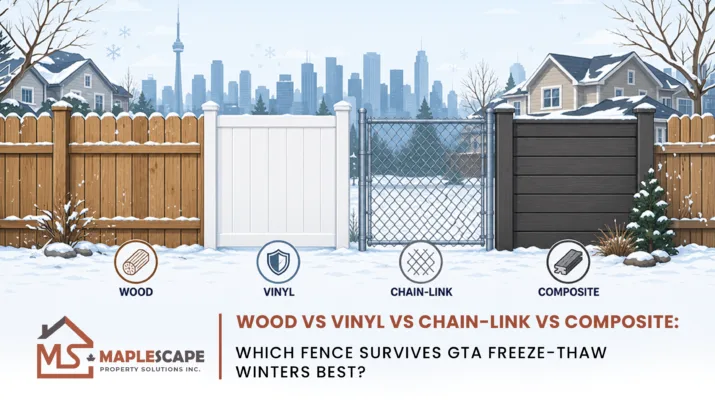
A Toronto fence does not experience winter only at the panel. Real stress often starts underground.
Water enters soil, freezes, expands, then thaws. Repeated movement can leave posts leaning, gates dragging, and panels misaligned. National Research Council Canada identifies water supply, frost-susceptible soil, and below-freezing temperatures as the key conditions behind frost heaving.
That is why fence installation Toronto should compare more than appearance and price. Material matters, but post design, soil, drainage, wind exposure, and installation depth can matter just as much.
Every major material can work in the GTA when the system suits the site.
1. Which Fence Material Handles GTA Winters Best?
There is no single winner. Chain-link tolerates moisture and stays open to wind. The composition is a strong low-maintenance privacy material. Vinyl avoids rotting when the system suits the climate. Wood remains repairable, but moisture management matters more.
| Material | Winter Performance | Service-Life Benchmark | Maintenance | Relative Upfront Cost |
| Pressure-treated wood | Good when posts and drainage are right | Site- and treatment-dependent | Highest | Low to mid |
| Vinyl/PVC | Very good with a cold-climate-rated system | Some systems carry limited lifetime warranties | Low | Mid |
| Galvanized chain-link | Excellent for an open boundary | Selected systems carry 12-year corrosion warranties | Very low | Lowest |
| Composite | Excellent for privacy applications | Some systems cite 20+ years and 25-year warranties | Very low | Highest |
The practical takeaway is to separate panel durability from foundation durability. A material may resist rot, corrosion, or staining very well while the fence still shifts because the posts were poorly founded. In GTA winters, the strongest specification treats the fence as one complete structural system.
These are planning benchmarks, not promises. Warranties and installations vary. Manufacturers place chain-links at the economical end and premium composite above basic wood or vinyl upfront.
2. Why Does Frost Heave Matter Than Most Fence Buyers Realize?
Frost heave is not simply cold damaging a panel. The important interaction is between freezing soil, moisture, and the foundation supporting the post.
Ontario’s Building Code says frost penetration depth should be established from local experience. It is not a universal fence-post rule, but it shows why one depth should not be copied to every site.
2.1 Post Depth Should Match the Fence System and Site
Manufacturer instructions make the same point.
Barrette bases vinyl post-hole depth on the local frost line plus gravel or filler. Master Halco says steel posts driven below the frost line gain protection against frost heave.
So “we always dig 30 inches” is not a reassuring answer by itself.
A better installer considers soil, drainage, wind, post material, gate loads, product instructions, and local frost conditions before choosing a foundation.
3. How Do Wood and Vinyl Compare Through Winter?
3.1 Wood: Repairable, but More Sensitive to Moisture
Wood is useful because individual boards, rails, and posts can often be repaired separately.
Its winter weakness is not freezing alone. Wood decay is strongly influenced by moisture and temperature, and Canadian field research shows preservative-treated posts resisting deterioration better than untreated wood under demanding exposure.
Pressure treatment, ground-contact suitability, drainage, sound fasteners, and inspection matter. A good panel on a decaying post is still a failing fence.
3.2 Vinyl: Low Moisture Maintenance, but Product Engineering Matters
Vinyl does not decay like wood. Current manufacturers offer systems described as resistant to freezing winters, moisture, cracking, and warping.
That does not make every vinyl panel interchangeable.
Rail reinforcement, post design, wall thickness, gates, expansion allowance, and approved installation matter. Rigid privacy panels can reveal small post movement quickly.
Vinyl is a strong low-maintenance option when the system is chosen for the climate rather than selected on appearance alone.
4. How Do Chain-Link and Composite Compare Through Winter?
4.1 Chain-Link: Strongest Where Openness Is an Advantage
Galvanized chain-link handles rain, snow, and frost well because zinc protects steel against corrosion, while open mesh creates less solid surface for wind to push against than a privacy panel. Master Halco describes galvanized chain-link as low-maintenance and resistant to rain, snow, and frost.
Its residential galvanized system carries a 12-year limited warranty against significant red rust when specified components and installation standards are met.
The trade-off is privacy. For side yards, pet boundaries, or open views, that simplicity can be an advantage.
4.2 Composite: Strong Privacy Performance with a Higher Entry Cost
Composite suits homeowners who want privacy without routine staining or sealing.
Trex states that its composite fencing does not rot, split, or splinter, requires no painting or staining, and carries a 25-year limited residential warranty. The manufacturer also describes the system as typically costing more upfront than wood or PVC/vinyl.
Composite boards cannot compensate for weak foundations. Solid privacy fences also catch more wind than chain-link, so spacing, reinforcement, height, and exposure still matter.
5. What Should You Ask Before Choosing a Winter-Ready Fence?
For fence installation Toronto, ask questions that reveal how the contractor thinks:
- How will you determine post depth for this soil and fence system?
- What post material and foundation method are you proposing?
- How does drainage around the fence line affect installation?
- Does this product have cold-climate installation guidance?
- How are gate posts reinforced?
- What happens where grade changes?
- Which warranty applies, and what can void it?
- How will buried utilities be located before excavation?
Ontario One Call requires locates before fence excavation, with the excavator responsible. Private infrastructure may need separate locating.
That is basic outdoor construction discipline worth confirming before equipment arrives.
For privacy, compare wood, vinyl, and composite around upkeep and price. For lower cost and open visibility, consider galvanized chain-link.
6. Conclusion
The best GTA winter fence is not the material with the strongest marketing claim.
Chain-link is strong for economical, low-maintenance perimeter fencing. Composite suits premium privacy. Vinyl offers low-maintenance privacy, while wood remains attractive and repairable when moisture and post durability are handled properly.
For fence installation Toronto, pay particular attention to what disappears underground. Post depth, drainage, soil, frost conditions, reinforcement, and wind exposure can decide whether a fence stays straight long after the first winter.
Choose around privacy, maintenance, and budget, then insist the foundation suits the site. Maple Scape can help Toronto and GTA homeowners compare options around both the yard they want and the winters it must handle.
Frequently Asked Questions
Which fence is least affected by freezing-thaw weather?
No fence is independent of its posts. Galvanized chain-link resists weather with low wind loading; composite is a strong privacy choice. Both still need sound foundations.
Does a fence post always need to be four feet deep in Toronto?
Do not use one universal depth. Ontario bases frost penetration on local experience, while manufacturer instructions vary by system, soil, frost conditions, and installation method.
Is vinyl fencing suitable for Toronto winters?
Yes, suitable vinyl systems can be designed for freezing climates. Choose a product with appropriate cold-weather guidance and follow its post, reinforcement, and installation requirements.
Does pressure-treated wood still need maintenance?
Yes. Treatment improves biological durability, but wood still benefits from inspection for moisture-related decay, loose hardware, damaged boards, and movement around posts.
Is composite worth the higher cost?
It can be when privacy and low maintenance are priorities. Some composite systems carry long warranties and avoid painting or staining, but the upfront investment should fit your budget.