
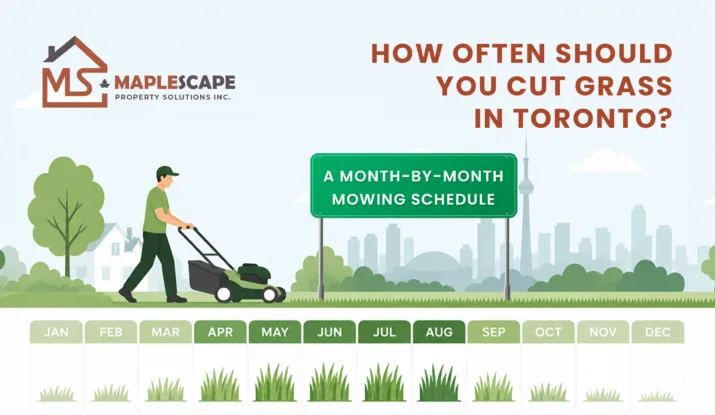
Toronto lawns do not grow at one steady speed from spring to fall. May can bring fast growth after rain, while a hot July may barely justify starting the mower.
That is why lawn mowing Toronto should follow grass growth rather than a rigid seven-day habit. Cool-season turf grows most actively in spring and fall and slows during heat or drought.
A useful schedule gives you a starting rhythm, then lets actual grass height decide whether a cut is needed.
1. How Often Should You Mow a Toronto Lawn?
The City of Toronto recommends keeping grass around 6 to 7.5 centimeters, or 2.5 to 3 inches, and mowing less during dry spells and summer. Turf specialists also recommend removing no more than one-third of the leaf blade in a single mowing.
During fast spring growth, a lawn may need to be cut every five to seven days. In hot, dry weather, the interval may stretch to ten or fourteen days, and dormant turf may not need to mow at all.
The schedule below is therefore a practical starting point, not a fixed prescription.
2. Lawn Mowing Toronto: April-to-November Schedule
| Month | Typical Starting Cadence | Target Height | What to Watch |
| April | Every 10–14 days once growth starts | 6–7.5 cm | Soft soil, slow green-up |
| May | Every 5–7 days | 6–7.5 cm | Rain can accelerate growth |
| June | Every 5–8 days | 6–7.5 cm | Fast early growth, later heat |
| July | Every 7–14 days or pause in drought | About 7.5 cm | Heat and moisture stress |
| August | Every 7–14 days | About 7.5 cm | Dry weather, then rain-driven growth |
| September | Every 5–8 days | 6.5–7.5 cm | Cooler weather can restart growth |
| October | Every 7–10 days | 6–7.5 cm | Growth gradually slows |
| November | As needed while grass grows | 6–7.5 cm | Frost, wet ground, seasonal shutdown |
These intervals are starting points. Penn State notes that spring growth can require mowing more than once weekly, while drought may make mowing unnecessary until growth resumes.
2.1 April to June: Follow the Spring Growth Surge
Wait until the lawn is actively growing, and the ground is firm enough to carry mower traffic. Toronto recommends mowing when grass is dry because wet clippings can clump and damage turf.
By May, weekly mowing is often reasonable. If grass grows quickly, mows earlier rather than removing too much at once.
June can behave like two seasons. A cool, rainy first half may need frequent cuts; a hot, dry second half may slow growth sharply. Cool-season turf leaf growth depends heavily on temperature and available moisture.
2.2 July and August: Mow Higher and Less Often
Summer is where automatic weekly mowing causes trouble.
Cool season grasses slow under heat and moisture stress. Toronto specifically recommends mowing less during summer and dry spells.
Keep the mower near the upper end of Toronto’s recommended range. Taller turf helps shade the soil and supports a stronger canopy.
If grass has stopped growing during drought, leave it alone. Cutting dormant turf simply adds stress without improving growth.
2.3 September to November: Expect Growth to Return
Cooler September conditions favor cool-season grasses, so a lawn that barely moved in August may need regular cutting again.
Continue through October while the grass grows. In November, mow only when growth and ground conditions justify it. Avoid an aggressive “winter scalp.” There is no benefit in cutting healthy turfs, unusually short just because cold weather is coming. University turf guidance recommends continuing to mow while grass remains actively growing.
3. Why Does Cutting Height Matter More Than a Weekly Habit?
Grass responds to how much leaf tissue you remove, not the day on your calendar.
Removing too much at once reduces photosynthetic leaf area and stresses the plant. University turf guidance uses the one-third rule as a practical limit and connects very short mowing with weaker turf and greater weed opportunity.
Toronto’s 6-to-7.5-centimeter recommendation keeps enough leaf areas to support roots and retain moisture and nutrients.
There is also an important local distinction. Toronto’s current turfgrass bylaw requires private property turfgrass to be cut when it exceeds 20 centimeters. That is a legal maintenance threshold, not a recommended mowing height for a healthy residential lawn.
4. What Should Make You Change Your Mowing Day?
A good schedule knows when to get out of the way.
Rain: Wait until the grass and soil are dry. Mowing saturated ground can leave ruts, while wet clippings can form heavy clumps.
Drought: Stretch the interval when growth slows. Cool-season turf can enter summer dormancy during heat and moisture stress, then resume growth after cooler weather or rainfall.
Shade: Shaded turf often benefits from additional leaf areas. Penn State recommends higher mowing in many shaded conditions because the grass is less available for light.
New turf: New sods or seedlings should not automatically join the normal calendar. Wait until they are established enough to tolerate mower and foot traffic.
A good Grass Cutting Service should respond to those conditions rather than cutting a lawn simply because another week has passed.
5. Which Mowing Habits Improve Lawn Health?
Keep mower blades sharp. Toronto recommends sharpening them twice per season, or about every eight to ten hours of use. Dull blades tear grass tips instead of making a clean cut.
Leave short, evenly distributed clippings on the lawn. Toronto encourages clipping return because it can help conserve moisture and return nutrients. University guidance also confirms that normal clippings do not create thatch.
Change mowing direction periodically. Alternating direction helps prevent repeated wheel tracks and encourages more upright growth.
Do not chase a golf course look by scalping residential turf. Shorter is not automatically better.
If you use grass cutting services in Toronto, ask about cutting height, blade conditions, and weather adjustments as well as visit frequency.
6. Conclusion
Expect faster growth in May and June, longer gaps during hot or dry summer weather, and another active period as September cools down. Keep most cuts within Toronto’s recommended 6 to 7.5 centimeters and avoid removing more than one-third of the blade at once.
Good lawn mowing Toronto is not about making every Saturday identical. It is about matching mowing frequency to growth, moisture, weather, and turf conditions.
If you would rather keep that seasonal rhythm off your weekend list, MapleScape can help maintain lawns across Toronto and the GTA.
Frequently Asked Questions
Is mowing once a week enough in Toronto?
Often, but not always. Spring may require shorter intervals, while summer heat or drought can extend them. Use grass height and the one-third rule to decide.
Should I move shorter during hot weather?
No. Toronto recommends 6 to 7.5 centimeters, and summer is generally a time to stay near the taller end of that range rather than cutting lower.
Should I mow brown grass during drought?
If drought-stressed turf has stopped growing, mowing may not be necessary. Reduce unnecessary mower and foot traffic until active growth returns.
Do grass clippings cause thatch?
Normally, no. Regularly produced clippings decompose quickly. Remove or redistribute unusually long clumps, but routine clipping return does not generally create thatch.
When should Toronto’s final lawn cut happen?
There is no fixed date. Keep mowing while grass grows and the ground is dry enough for clean mower traffic. Depending on the year, that can extend into November.