
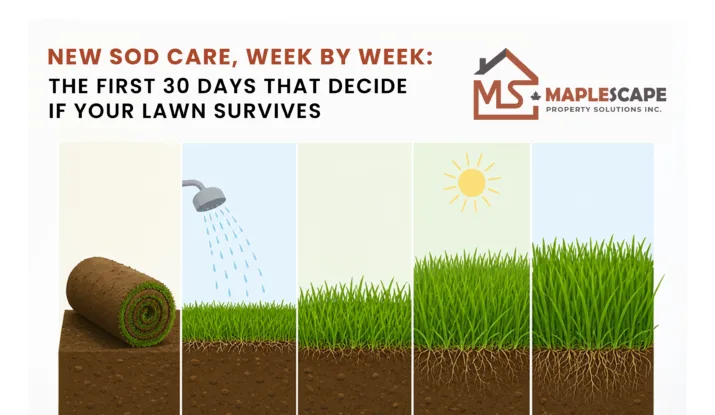
Fresh sod gives you the satisfying part first: a green lawn in a single day. The harder part starts after the crew leaves.
Those first four weeks are when roots move from the thin sod layer into the soil below. Too little water can dry edges; constant saturation can also cause problems. Mow too early or let a sunny corner dry, and an even installation can quickly become patchy.
Good lawn care and maintenance during the first 30 days is less about doing more and more about adjusting care as roots develop.
1. What Matters Most During the First Month?
The new sod is not an established lawn yet.
University of Minnesota Extension recommends keeping newly laid sod moist but not saturated until it is firmly rooted, then gradually reducing watering. It suggests a gentle “tug test” after roughly 10 to 14 days: resistance when you lift a corner indicates roots are attached to the soil.
That test is more useful than following a calendar blindly. Rooting changes with temperature, rainfall, soil, shade, wind, and preparation.
Three things deserve your attention throughout the month:
- moisture where the sod meets the soil;
- whether pieces are beginning to resist lifting;
- How quickly the grass is growing.
Let those signals guide care rather than the sprinkler timer.
2. Week 1: Keep the Root Zone Moist Without Flooding It
The first week is mostly about water and restraint.
Illinois Extension advises watering new sod thoroughly, so moisture reaches the soil underneath, then checking beneath a lifted corner to confirm that soil remains moist. Sod does not always need watering as often as homeowners assume.
2.1 Check the Soil, Not Just the Grass
Green blades can look fine while the soil underneath is beginning to dry.
Lift a corner gently in several locations, especially beside driveways, patios, or sunny edges. You want moisture below the sod, not standing in the water.
Rain counts too. If Toronto gets a useful rainfall, adjust irrigation instead of watering because the timer says so.
After Sod Installation Toronto, this hands-on moisture check is especially valuable during week one.
Keep unnecessary traffic and furniture off the lawn. Newly laid pieces can shift before roots grip the soil.
One more checkout: sprinkler coverage. Place a few containers across the lawn during irrigation and compare what they collect. Uneven amounts can reveal dry zones before color changes become obvious, especially around corners, slopes, and narrow strips.
3. Week 2: Start Looking for Roots Before Changing the Routine
By week two, the lawn may look settled while roots are still developing.
University of Minnesota Extension recommends a tug test around days 10 to 14. Resistance to a gentle pull shows that roots are attached, and watering can begin transitioning from constant surface moisture.
Do not reduce water just because two weeks have passed. Check out several locations.
Shade, dry edges, and weaker soil contact can produce different rooting speeds.
3.1 Watch for Warning Signs
A few observations can tell you that something needs attention:
- seams are opening or edges are curling;
- sections remain soft or excessively wet;
- one sprinkler zone stays noticeably drier;
- pieces still lift easily after surrounding areas have rooted;
- footprints sink deeply into the soil.
These signs do not automatically mean failure. Inspect moisture, irrigation coverage, soil contact, and drainage before choosing a fix.
4. Week 3: Shift from New-Sod Care Toward Normal Lawn Habits
Once sod is rooted, encourage roots into deeper soil rather than keeping only the surface wet.
Toronto’s current guidance for established lawns recommends morning watering and approximately 2.5 centimeters of water per week, including rainfall. The city also notes that clay soils generally need less frequent watering than sandy soils.
Do not jump to that established-lawn target while the sod is still loose. Transition according to rooting, weather, and soil moisture.
Mowing often enters the picture now.
Illinois Extension recommends mowing newly sodded lawns once the grass reaches roughly 3 to 4 inches and removes no more than one-third of its height at a time. Toronto’s established lawn guidance recommends maintaining grass around 6 to 7.5 centimeters, or 2.5 to 3 inches.
Use a sharp mower blade and avoid mowing when the lawn is saturated.
5. Week 4: Treat the Lawn as Established Only If It Is Acting Established
Thirty days are a milestone, not a guarantee.
If turf is firmly rooted, color is reasonably even, and irrigation no longer exists just to keep the sod layer moist; lawn care and maintenance can begin resembling an established routine.
Use this day-30 check:
| Check | Healthy Direction | Reason to Investigate |
| Rooting | Sod resists gentle lifting | Pieces still lift easily |
| Moisture | Soil stays evenly moist between watering | Persistent sogginess or rapid drying |
| Color | Generally consistent | Expanding yellow or brown areas |
| Surface | Seams settling together | Widening gaps or curled edges |
| Mowing | Turf stays anchored | Mower lifts or shifts sod |
Avoid rushing into extra fertilizer just because the lawn is new. Illinois Extension advises waiting until the next appropriate normal fertilizing period rather than automatically fertilizing newly laid sod.
This is where longer-term lawn maintenance Toronto begins: mowing height, irrigation, nutrition, weeds, compaction, and weather become more important than installation-day care.
6. Conclusion
The first month with a new sod should feel progressively easier.
Week one is about protecting moisture and keeping traffic away. Week two is about checking whether roots are attached. Week three begins the transition toward deeper, less frequent watering and normal mowing. By week four, the lawn should be moving toward established care if rooting and growth are progressing well.
Good lawn care and maintenance do not mean following the same schedule every day for 30 days. It means watching the turf, checking the soil, accounting for Toronto weather, and changing your routine as roots develop.
If you want help with the transition, Maple Scape can support ongoing lawn care after sod installation across Toronto and the GTA.
Frequently Asked Questions
How often should I water the new sod during the first week?
There is no universal times-per-day rule. Water thoroughly after installation, then monitor the soil beneath the sod and keep it moist without saturation. Heat, wind, rain, shade, soil, and irrigation coverage change drying speed.
When can I walk on a new sod?
Keep traffic off while the sod is loose. Check firm rooting with a gentle tug around days 10 to 14. Even after rooting begins, avoid heavy play or furniture until the turf is established.
When should the new sod get its first mow?
Mow when the turf is anchored and grass reaches the proper height. Illinois Extension suggests mowing around 3 to 4 inches while following the one-third rule.
Should I fertilize a new sod during the first 30 days?
Do not assume new sod needs immediate fertilizer. Illinois Extension recommends waiting for the next normal fertilization period. Soil conditions, previous amendments, season, and installer guidance should determine nutrition.
Why are the edges of my new sod turning brown first?
Edges and seams can dry faster because they are more exposed to air and heat. Check moisture underneath and confirm sprinkler coverage. Add water based on actual soil moisture, not color alone.