
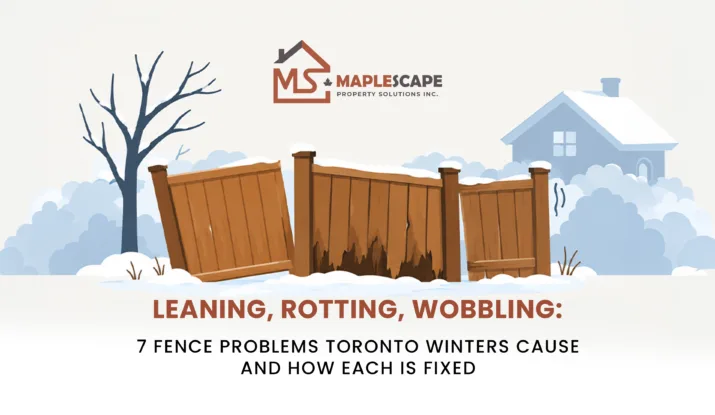
A fence that looked straight in October can look different after snowmelt. Winter has a way of revealing small weaknesses that summer hides. For fence repair toronto, spring diagnosis matters because winter damage is rarely cosmetic. Freezing soil can move foundations, moisture can expose decay, and movement can pull rails, panels, gates, and hardware out of alignment.
The good news is that one winter symptom does not automatically mean replacing the whole fence. First find where the failure starts.
1. Why Do Fence Problems Become More Obvious After a Toronto Winter?
Frost heave needs three ingredients: freezing temperatures, frost-susceptible soil, and available water. National Research Council Canada research explains that freezing can draw moisture toward ice lenses in soil, creating upward pressure and ground movement.
Small changes in one footing can affect neighbouring panels and gates.
Toronto requires fences to be kept structurally sound and free from hazards.
Start by walking both sides where accessible. Look along the top line, push gently at several posts, open every gate, and inspect wood close to grade.
2. Fence Repair Toronto: What Causes Leaning and Wobbling?
2.1 Problem 1: One Post Starts Leaning
A leaning section often points to the post rather than the panel.
Possible causes include frost-related soil movement, a deteriorated wood post, disturbed soil, or a footing that no longer holds securely. Before straightening anything, determine whether the post itself is sound.
Typical fix: A healthy post may sometimes be reset or its foundation corrected. A decayed, split, or badly damaged post is usually replaced, with adjacent sections supported during work.
Photo clue: Take a full-height photo from several metres away so the lean can be compared with neighbouring posts.
2.2 Problem 2: The Fence Wobbles When You Push It
Wobbling suggests movement somewhere in the structural chain.
Check whether the post moves at ground level, rails move at their connections, or only the panel flexes. Several wobbling posts usually deserve a broader foundation assessment.
Typical fix: Repair the loose connection. That may mean resetting or replacing a post, renewing fasteners, or repairing rail-to-post connections.
Do not keep adding screws if the post itself moves into the soil.
3. What Do Rot, Splitting, and Loose Boards Tell You?
3.1 Problem 3: Wood Is Soft or Rotting Near Ground Level
Moisture is the important clue.
The Canadian Wood Council explains that excessive moisture enables decay fungi and that controlling moisture is central to wood durability. Ground-level areas deserve attention because posts can remain wet longer there.
Probe suspicious wood gently with a screwdriver. Soft, crumbly material or clear loss of section suggests more than a surface-finish problem.
Typical fix: Replace structurally decayed components and address conditions that keep them unusually wet. Sound boards with coating wear may only need drying, preparation, and refinishing.
3.2 Problem 4: Boards Split, Shrink, or Pull Away
Exterior wood gains and loses moisture. The Canadian Wood Council notes that moisture changes cause wood to shrink and swell.
Small checks are not automatically structural failure. Concern rises when splitting reaches fasteners; boards become loose, rails crack, or openings compromise stability.
Typical fix: Replace isolated failed boards or rails while retaining sound material. If splitting is widespread, inspect the system rather than repair each board separately.
Photo clue: Include the whole board and a close-up showing how the split relates to fasteners.
4. Why Do Gates Sag and Panels Pull Out of Line?
4.1 Problem 5: The Gate Suddenly Scrapes or Will Not Latch
A gate often reveals small movement first because its clearances are tight.
Before adjusting the hinges, compare the two gate posts. If one shifted, moving the latch treats the symptoms rather than the cause.
Check hinge screws, frame squareness, post plumb, latch alignment, and ground clearance.
Typical fix: Replace or tighten hardware when hardware is the problem. Repair a distorted frame. Reset or replace a moving support post before making final gate adjustments.
4.2 Problem 6: Rails or Panels Separate from Posts
When a post shifts, rails and panels absorb the change. Connections can loosen, fasteners can pull, and gaps can open.
Typical fix: Stabilize post alignment first. Then renew damaged connections, rails, brackets, or panels. Reattaching everything before correcting post movement can leave the fence stressed.
A wide photo along the fence line helps show whether separation is isolated or repeated.
5. When Is Hardware Damage a Small Repair, and When Is It Warning?
5.1 Problem 7: Fasteners, Hinges, or Brackets Become Loose or Corroded
Winter moisture can expose weak hardware, but rust color alone does not tell you how much strength remains.
Look for loose screws, enlarged holes, badly corroded connectors, binding hinges, missing fasteners, and brackets pulling away from wood.
Typical fix: Replace failed hardware with components suitable for the fence material and exterior exposure. If screws no longer hold because surrounding wood deteriorates, fix the wood first.
One loose hinge is maintenance. Multiple failed posts, decayed rails, unstable panels, and repeated repairs justify comparing partial or full replacement.
If post replacement requires digging, Ontario One Call says a utility location must be requested before excavation. When a contractor is digging, confirm that the contractor has arranged the required locations.
That step belongs to responsible property maintenance services, not only new construction.
Conclusion
Winter can make a fence look suddenly tired, but the visible symptom gives you a useful starting point.
A lean sends you toward the post and footing. Wobbling sends you toward structural connections. Soft wood points to moisture and decay. A scraping gate asks you to check post alignment before touching the latch. Separating panels tell you to look for movement upstream.
That diagnostic order makes fence repair Toronto more focused and can preserve sound parts instead of replacing them unnecessarily.
Frequently Asked Questions
Can frost heave make only one fence post lean?
Yes. Frost action depends on local soil, moisture, freezing conditions, and foundation details, so movement can be uneven. Inspect neighboring posts before assuming the problem is isolated.
Should a wobbling fence post always be replaced?
No. The repair depends on whether the post is structurally sound and why it moves. A decayed post usually points toward replacement; a sound post may have a foundation problem.
Can rotten fence boards be repaired instead of replaced?
Surface weathering differs from structural decay. If wood has lost strength because of decay, replacement is usually more sensible. Minor finish deterioration on sound wood may be maintainable.
Why does my gate stop closing after winter?
Post movement, loose hinges, frame distortion, or ground changes can alter clearances. Check post alignment before moving the latch or cutting material from the gate.
When should I inspect my fence after winter?
Early spring, after snow clears and the ground is accessible, is practical. Inspect again after major storms or whenever a section starts moving, leaning, or creating a hazard.