
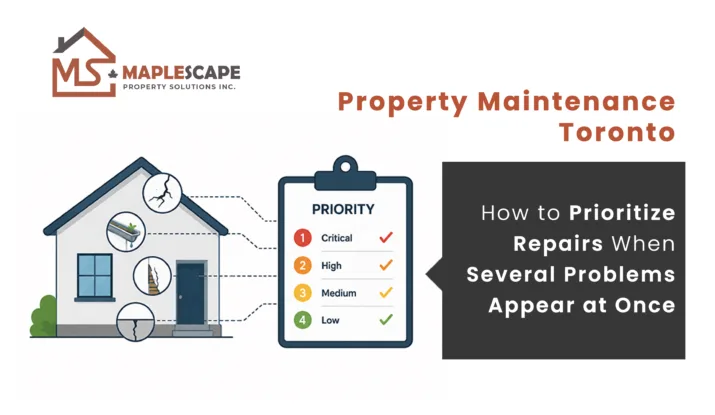
Property rarely gives you one problem at a time. You may notice a loose railing, a dragging gate, water beside the walkway, and a fence section beginning to lean within the same few weeks.
That is when maintenance stops being a simple repair decision and becomes a priority decision.
For homeowners thinking about Property Maintenance Toronto, the useful question is not, “What looks worst?” It is, “What could affect safety, water movement, support, or another part of the property if I leave it?”
A clear order can make repairs feel more manageable.
1. Why Does Repair Prioritization Feel So Difficult?
Most homeowners are not ignoring repairs. They are trying to decide what actually needs attention first.
Visible damage can be misleading. Peeling paint may look worse than a loose handrail. A crooked fence panel may attract attention before recurring drainage is done. One issue may be annoying while another quietly affects how the property functions.
That is why prioritizing appearance alone usually does not help.
Toronto’s Property Standards require owners to repair and maintain their properties, including stairs, decks, handrails, retaining walls, roofs, and other structures in safe, good repair.
The practical takeaway is simple: start with consequence, not cosmetics.
2. Property Maintenance Toronto: What Should You Fix First?
When several problems appear together, sort them by what they affect.
2.1 Start with Safety and Everyday Access
Anything that can affect how people enter, leave, walk through, or use the property should move higher on the list.
That includes loose railings, unstable steps, significant trip points, damaged decking, or a gate that creates an access issue.
Toronto specifically requires stairs, porches, decks, ramps, balconies, guards, handrails, and their support to be maintained in a safe condition and good repair.
Do not assume every uneven surface is dangerous. Look at where it is, how much it changed, and how often people use that route.
2.2 Move Water Problems Up the List
Water is easy to postpone because it disappears.
If the same area becomes wet after rainfall or snowmelt, follow the pattern. Check grading, drainage paths, downspouts, hardscape, fence posts, and retaining features.
The water itself may not be repaired. It may show you where another problem begins.
If you repair shifting paving without understanding why the ground stays wet, you may revisit the same area later.
3. Which Problems Can Usually Wait, and Which Deserve Faster Attention?
Not every repair needs the same response.
A useful way to sort out several problems is to ask whether the issue affects safety, function, water management, stability, or appearance.
| Priority | Example | Why It Matters |
| Higher | Loose railing or unstable step | Can affect safe everyday use |
| Higher | Recurring water beside structures | May contribute to surrounding deterioration or movement |
| Medium | Leaning fence post or dragging gate | Can worsen alignment and function |
| Medium | Settling pavers or shifting borders | May become a larger access or drainage issue |
| Lower | Faded finish or minor staining | Usually cosmetic when the material remains sound |
This is not a universal schedule. It keeps cosmetic problems from taking attention away from functional ones.
If something is actively moving, repeatedly getting wet, or becoming less stable, it deserves a closer look even if it does not appear dramatic.
4. How Can You Tell When Several Repairs Are Actually Connected?
This is where homeowners can avoid repeated frustration.
Three repairs in the same part of the yard may be separate, but they can also share one underlying condition.
4.1 Look for Water Plus Movement
Imagine that one walkway edge is sinking, the soil beside it stays wet, and the nearest fence post has begun leaning.
It would be easy to book three separate fixes. Before doing that, look at how water moves through the area.
If moisture and settlement appear together, the repair plan should consider both conditions rather than treating each visible symptom independently.
The same thinking applies to retaining walls. Toronto requires them to remain structurally sound, maintained, and free from hazards. A wall changing shape alongside drainage or soil movement deserves more attention than staining alone.
4.2 Pay Attention to Repairs That Keep Coming Back
A problem becomes more informative when it returns.
If the same crack reopens, a gate repeatedly falls out of alignment, or the same pavers keep shifting, stop asking how to make the next adjustment.
Ask what remains unchanged.
Recurring problems can point to movement, moisture, weak support, deterioration, or another nearby condition. Even a small repair benefits from understanding the pattern.
5. How Should You Plan Repairs When Time or Budget Is Limited?
You do not need to complete every outdoor repair at once.
A better approach is to create a repair order based on risk, function, and what may worsen if delayed.
Walk the property once without fixing anything. Take photos, note what changed, then group issues into practical categories:
- safety and access;
- active water or drainage concerns;
- movement or instability;
- recurring functional problems;
- cosmetic work.
Next, look for an overlap. If two or three issues sit in the same area, inspect them together before scheduling separate repairs.
Professional property maintenance can also help. Maple Scape currently lists fence and gate repairs, pavement and walkway restoration, border and perimeter levelling, driveway and hardscape repairs, and general exterior fixes across Toronto and the GTA.
A broader inspection does not mean everything needs professional repair. It can help separate action now from monitoring.
6. Conclusion
Several repairs appearing at once can make a property feel as though everything is urgent. Usually, it is not.
Start with what affects people. Then follow water, look for movement, and pay attention to problems that keep returning. Once those priorities are clear, cosmetic and lower-risk work becomes easier to schedule.
The goal of Property Maintenance Toronto is not to repair every imperfection immediately. It is to understand what matters first, what may be connected, and what can reasonably wait.
Frequently Asked Questions
What property repair should I prioritize first?
Start with anything affecting safety, safe access, active water problems, or structural stability. After that, consider recurring functional issues and then cosmetic work.
Should I repair drainage problems before fixing a walkway?
If recurring water appears to be contributing to settlement or movement, understand the drainage issue first. Otherwise, the repaired surface may continue experiencing the same conditions.
How do I know if two property problems are connected?
Look at location, timing, and recurrence. Problems that appear near each other, worsen after the same weather, or repeated return may deserve to be assessed together.
Can cosmetic exterior repairs wait?
Often, yes, if the issue is truly cosmetic and the material remains stable and functional. Continue monitoring because appearance changes can sometimes accompany deeper deterioration.
When should I call a property maintenance professional?
Professional help can be useful when the cause is unclear; several repairs seem connected, movement continues, or you are unsure which issue should be handled first.