
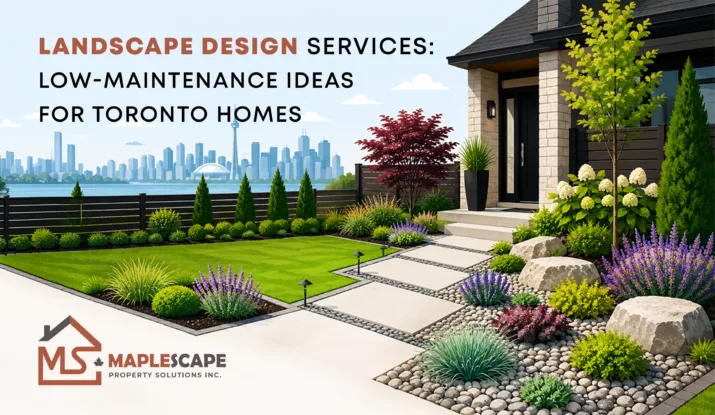
A low-maintenance yard still needs care, but the work should be easier, more predictable and better suited to the property. For Toronto homeowners, that often means choosing plants that fit local conditions, reducing areas that demand constant mowing or watering, improving soil coverage and planning outdoor features around how the space is actually used.
Good landscape design services should focus on future upkeep as much as appearance. A garden can look impressive after installation yet become difficult to manage if it needs constant trimming, watering or replacement planting. The better approach is to reduce unnecessary work before it becomes part of your routine.
What Makes Landscaping Low Maintenance?
Low maintenance starts with fewer recurring problems, not fewer plants.
A practical landscape reduces tasks that have to be repeated every week or season, such as constant mowing, hand watering, aggressive pruning, weed control, and replacing plants that are poorly suited to the site.
The goal is to make maintenance easier and more worthwhile.
That usually means looking at the whole yard rather than changing one feature at a time. Lawn size, planting density, drainage, soil coverage, edging, pathways and access all influence how much work the property requires.
A yard with simple circulation and well-spaced planting may need less attention than one filled with small lawn strips, crowded beds and unnecessary borders.
How Can Landscape Design Services Reduce Ongoing Upkeep?
Effective landscape design services reduce maintenance by making fewer features fight against the site.
A good plan can:
- keep lawn only where it is useful
- choose plants based on sunlight and moisture
- simplify mowing and edging
- use mulch in appropriate garden areas
- create clear access for seasonal cleanup
- avoid overcrowded planting
- organize hardscape and softscape as one layout
- address drainage before it damages lawn or planting
Reduce Lawn Where Grass Adds Little Value
A lawn makes sense where open space is regularly used. Grass in narrow side yards, steep corners, heavily shaded sections or awkward edges may create mowing work without adding much function.
Unused turf can sometimes be replaced with planting beds, groundcovers, mulch or another suitable surface. The best choice depends on sunlight, moisture, drainage, and foot traffic.
Keep grass where it supports recreation, pets, or flexible outdoor use.
Simplifying the shape of the remaining lawn also helps. Long clean edges are easier to mow than multiple tight curves, isolated patches, and narrow strips.
Choose Plants for the Site, Not Just Appearance
Plant selection has a major effect on future maintenance.
Plants that struggle with available light, soil or moisture may need extra watering, pruning, or replacement. Plants that grow too large for their location can create years of unnecessary trimming.
Before selecting plants, consider:
- Sunlight: Does the area receive full sun, partial shade or deeper shade?
- Moisture: Does the soil stay dry, drain quickly, or remain damp?
- Mature size: Will the plant still fit comfortably several years from now?
- Location: Is it close to a walkway, fence, foundation, or high-traffic area?
- Care needs: Does it require frequent pruning, dividing or watering?
- Seasonal behavior: Will leaf drop or dieback create cleanup where those matter?
Choosing fewer plants that suit the site usually works better than filling every open space immediately.
Use Mulch and Better Bed Spacing
Mulch can help planted areas retain moisture, moderate soil conditions, and reduce some weed pressure when used appropriately.
Bed design matters too.
New shrubs and perennials can look small, which often encourages people to plant them too closely. Once they mature, crowded beds may need frequent pruning, dividing, or removal.
Plan around mature plant size rather than how full the garden looks on installation day.
Leave enough space for plants to develop naturally and use mulch to cover open soil during establishment. This can create a cleaner layout without forcing plants together simply for instant fullness.
Simplify Edges, Pathways and Hardscape Features
Complex shapes create extra work.
A lawn with many tight curves and isolated corners takes longer to mow and edge. The same principle applies to garden beds and pathways. Too many disconnected features create more borders to trim, surfaces to clean and transitions to manage.
A simple layout does not have to look plain.
Visual interest can come from planting height, texture, material changes, and seasonal color instead of a large number of separate features.
Before adding something, ask whether it improves how the yard works or mainly creates another area that needs attention.
Patios and pathways should also be sized for their actual use. Oversized hardscapes can create unnecessary cleaning and reduce useful planting spaces.
Design Around Water and Drainage
Repeatedly wet areas can become maintenance problems if the landscape ignores how water moves through the property.
A low spot may struggle to support the turf. A hard surface may direct runoff toward planting. A downspout or slope may repeatedly saturate in one section.
The first step is to understand the cause rather than repeatedly replacing grass or plants.
In some locations, changing planting, improving soil conditions, using water-tolerant species or reviewing drainage may make the area easier to manage.
More serious drainage concerns, especially near foundations, should be assessed before decorative landscaping is added.
Think About Seasonal Cleanup Before You Plant
Low maintenance should account for spring and fall, not only for summer.
Leaves, spent perennials, lawn edges and garden beds all change through the seasons. A yard that looks manageable in June may become difficult if every planting area is hard to reach by October.
Keep access practical.
Avoid narrow spaces that cannot be cleaned easily. Group planting logically. Decide which areas need a formal, tidy appearance and which can remain more natural.
This makes seasonal maintenance more predictable rather than turning every cleanup into a larger project.
Build a Yard That Is Easier to Maintain
The best low-maintenance landscape is not the one with the fewest plants. It is the one where lawn, planting beds, pathways, and outdoor features have been chosen with future care in mind.
For Toronto homeowners, reducing unnecessary lawns, choosing suitable plants, managing moisture and simplifying the layout can make regular upkeep more manageable overall.
If several parts of the property need improvement, professional landscape design services can connect those decisions into one practical plan rather than creating separate maintenance problems that become harder to manage over time.
Frequently Asked Questions
What is the easiest landscaping to maintain?
Simple layouts with well-spaced plants, manageable lawn areas, practical mulch use and durable pathways are generally easier to maintain than crowded designs with many small features.
Are native plants low maintenance in Toronto?
They can be matched to suitable sunlight, soil, and moisture conditions. Native does not mean maintenance-free, so site selection still matters.
Does mulch reduce yard maintenance?
Mulch can help retain moisture and suppress some weeds, which may reduce routine watering and weeding when it is used correctly.
Should I remove my entire lawn?
Not necessarily. Keep the lawn where it has a useful purpose and consider replacing only difficult, unused or awkward sections.
Can professional landscape design reduce long-term upkeep?
Yes. Good planning can simplify lawn shapes, improve plant spacing, organize drainage and match materials and planting choices to the level of maintenance you want to manage.