
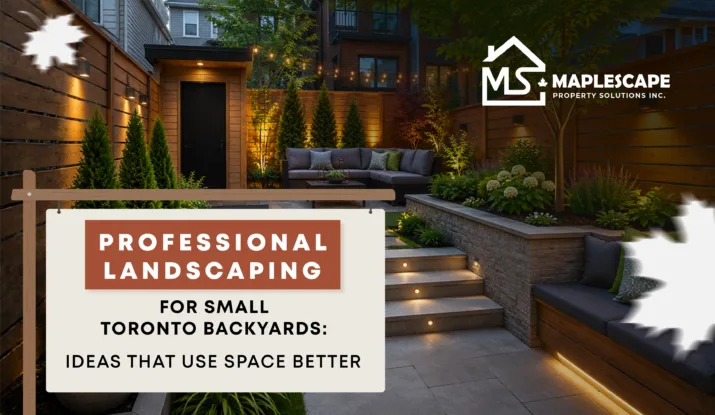
A small backyard does not need dozens of features to feel complete. In a limited Toronto outdoor space, every square foot has to earn its place. The right layout can create room for seating, planting, movement, and privacy without making the yard feel crowded.
For homeowners considering professional landscaping, the priority should be functioning before decoration. Compact yards usually work best when the design reduces clutter, uses vertical space, chooses plants based on mature size and creates clear zones for the activities that matter most.
The goal is not to make a small yard look large. It is to make the available space feel intentional, comfortable, and easier to use.
Start With How You Want to Use the Backyard
Before choosing plants, paving or furniture, decide what the yard needs to do.
One household may want a quiet seating area, while another may need room for children, pets, gardening, or outdoor dining. Trying to include everything often leaves a small backyard fragmented.
Start with one or two priorities.
- One main seating zone: A defined patio or deck gives the yard a clear purpose.
- Narrow planting borders: Beds along fences can add greenery without taking over the center.
- Simple circulation: Paths should feel natural rather than forcing people around obstacles.
- Some open space: Leaving part of the yard visually open can make it feel less crowded.
Good planning creates a breathing room.
How Can Professional Landscaping Make a Small Yard Work Better?
Good professional landscaping does not try to squeeze as many features as possible into a compact yard. It decides which features deserve space and which ones can be removed.
In a compact yard, priorities usually produce a stronger result than adding features simply because space remains.
Use Vertical Space Instead of Filling the Ground
When ground area is limited, fences, walls and upright structures become useful for design opportunities.
Climbing plants, trellises, narrow planters and layered planting can add greenery without consuming much floor space.
Vertical planting still needs planning. Consider sunlight, airflow, mature spread, and whether the supporting structure can handle the plant over time.
Tall elements should also be placed carefully. If every boundary is filled with dense vertical screening, the yard can feel closed in. Use height where it creates privacy, greenery or visual interest rather than on every available surface.
Keep the Layout Simple and Connected
Too many materials can make a compact backyard feel busy.
Using a limited palette for paving, edging, fencing, and planters usually creates a cleaner result. Repeating one material or shape can visually connect to different zones.
Choose Plants That Will Still Fit Later
A plant that looks small today may become too large for a narrow backyard.
Before planting, consider mature height and width, root space, sunlight, soil moisture and distance from fences, pathways or structures.
Compact shrubs, perennials, ornamental grasses and suitable groundcovers can provide texture without constant cutting back.
The most common planning mistake is choosing plants for their installation size rather than their mature size. That can lead to overcrowding, repeated pruning, and blocked pathways a few years later.
Give plants enough room to develop naturally and use spacing to keep the yard visually organized.
Reduce Lawn If It Adds Little Function
A tiny patch of grass is not automatically the best use of a small backyard.
If the lawn is difficult to mow, heavily shaded or too small for recreation, replacing some of it with planting, groundcover, a patio or another functional surface may simplify upkeep.
Grass can still be useful for children, pets, or flexible open spaces.
The question is whether the lawn has a purpose.
A compact, usable lawn is often easier to maintain than several narrow turf sections around patios, beds and pathways. Simplifying the shape can also make mowing and edging faster.
Create Privacy Without Closing the Yard In
Privacy matters in many Toronto backyards where neighboring properties sit close together.
The mistake is creating a heavy barrier on every side. Tall, dense screening can provide privacy but may also make a compact space feel boxed in.
Instead, identify the sightlines that matter most.
A seating area may need screening behind it. A neighboring window may require a targeted shrub, trellis, or fence section. Another boundary may not need extra height at all.
Fencing, shrubs, trellises, and climbing plants can work together. Keeping some areas visually lighter can preserve a sense of openness while still improving privacy where it matters.
Plan Around Water, Shade and Site Conditions
Small yards can have very different conditions within only a few meters.
One corner may remain shaded while another receives strong afternoon sun. Buildings and fences can also change how quickly soil dries or how water moves after rain.
Drainage matters too. If water regularly collects in one area, do not simply cover it with new sod or planting. Understand whether grading, soil conditions or another site issue needs attention first.
In a small yard, every weak area is noticeable. Matching plants and surfaces to the site can prevent repeated watering, replacement, and maintenance later.
Use Hardscaping Where It Adds Function
Patios, walkways, and edging can make a small backyard easier to use, but each feature should solve a practical need.
A patio can create stable seating. A pathway can connect a door to a gate or shed. Edging can separate planting from lawn or gravel.
The key is proportion.
Oversized paving can make a small yard feel hard and enclosed, while too many surfaces create visual clutter. Balance hard materials with planting and open space, so the yard still feels comfortable.
Make Every Part of the Yard Work Harder
A successful small backyard is not defined by how many features fit inside it. The better measure is how comfortably space supports everyday use.
For Toronto homeowners, a simple layout, appropriately sized plants, selective lawn areas, targeted privacy and practical hardscaping can make a compact yard more useful and manageable.
If several improvements need to work together, professional landscaping can organize them into one clear plan. The result should not be a backyard filled with more things. It should be a backyard where the available space works better every day.
Frequently Asked Questions
How can I make a small backyard look bigger?
Keep the layout simple, limit materials, leave some open space and place much of the planting around boundaries. Clear sightlines can also help the yard feel less crowded.
What plants work best in a small Toronto backyard?
Choose plants based on mature size, sunlight, soil, and moisture. Compact shrubs, perennials, and groundcovers are often easier to manage than large, fast-growing plants.
Is grass necessary in a small backyard?
No. Keep grass only when it serves a useful purpose. Difficult lawn areas can sometimes be replaced with planting, groundcover, or functional hardscaping.
How do I create privacy in a small backyard?
Focus screening where privacy is actually needed. Fencing, shrubs, trellises, and climbing plants can block key sightlines without enclosing the entire yard.
Is professional landscaping worth it for a small yard?
It can be. Professional planning can help coordinate planting, hardscaping, privacy, drainage and movement, so limited space feels organized rather than crowded.