
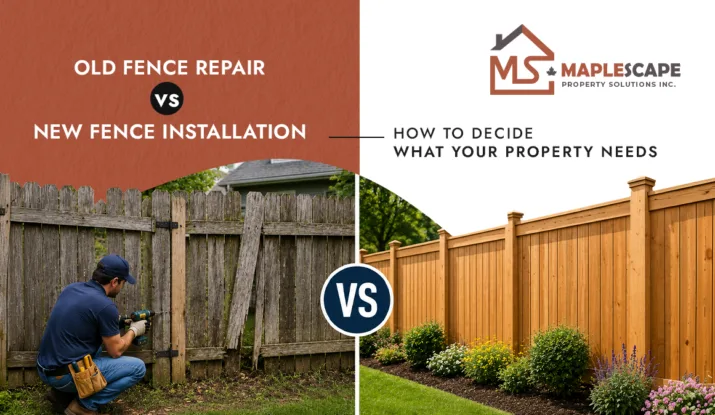
A fence can look worn out long before it fully fails. Loose boards, leaning posts, rust, broken panels, or a sagging gate can make homeowners wonder whether repair is enough or if a complete replacement is the better choice.
The decision between old fence repair and new fence installation should not be based only on appearance. Age, structure, material condition, repair cost, safety, and long-term use all matter. For homeowners comparing fence repair and fence installation in Toronto options, understanding these factors can help avoid unnecessary spending and make a smarter property decision.
How Do You Know If Your Fence Can Be Repaired?
Repair is usually practical when the fence has limited damage and the overall structure is still stable.
Fence repair may be enough if:
- Only a few boards or panels are damaged
- One gate needs adjustment
- A small section is leaning
- Rust or wear is limited
- The posts are still strong
- The fence still provides privacy and security
In these cases, targeted repair can restore the fence without replacing the entire structure.
For example, replacing damaged boards, tightening fasteners, repairing hinges, or reinforcing one post can often extend the life of the fence at a lower cost.
When Is New Fence Installation the Better Choice?
A full replacement becomes more practical when the fence has widespread damage or no longer serves its purpose.
New fence installation may be better if:
- Multiple posts are loose or rotten
- Large sections are leaning
- Several panels are cracked, broken, or missing
- Wood rot has spread across the structure
- Metal fencing has deep rust or corrosion
- Repairs are becoming frequent
- The fence no longer fits your privacy or design needs
At a certain point, repeated repairs become temporary fixes. If the fence continues to fail in different areas, replacement may offer better long-term value.
Is It Cheaper to Repair or Replace a Fence?
Repair is usually cheaper upfront, but it is not always the most cost-effective option over time.
Fence repair works well when the issue is small and isolated. However, if the fence is old and multiple areas need attention, repair costs can add up quickly.
Before deciding, consider:
- Current repair cost
- Age of the fence
- Expected remaining lifespan
- Material condition
- Future maintenance needs
If repairs cost a large portion of a new fence, replacement may be the smarter investment.
This is where a proper inspection helps. A professional can identify whether the problem is limited or part of a larger structural decline.
How Does Fence Age Affect the Decision?
Fence age is one of the most important deciding factors.
A newer fence with minor damage is usually worth repairing. An older fence with repeated issues may not be.
General considerations:
- Wood fences often require more maintenance as they age
- Metal fences may remain strong longer if rust is controlled
- Vinyl fences can last well but may need panel replacement after impact
- Poorly installed fences may fail earlier than expected
If the fence is near the end of its expected lifespan, investing in repeated repair may only delay replacement for a short time.
What Should a Contractor Inspect Before Recommending Repair or Installation?
A proper fence inspection should go beyond visible damage.
Key areas to check include:
- Post stability
- Soil movement around the base
- Board or panel condition
- Gate alignment
- Fasteners and brackets
- Rust, rot, or cracks
- Fence line alignment
- Drainage near the fence
Posts are especially important. A fence with strong posts can often be repaired. A fence with failing posts usually needs more serious work.
For homeowners searching for fence repair in Toronto, the goal should be to get an honest assessment, not just a quick surface-level fix.
Can a Leaning Fence Be Fixed Without Replacing It?
Sometimes, yes.
A leaning fence can often be repaired if the post has shifted but is not badly damaged. The solution may involve resetting the post, reinforcing the base, or correcting soil support around it.
However, replacement may be needed if:
- The post is rotten
- The concrete base has failed
- Multiple posts are leaning
- The fence line is no longer stable
A leaning fence should not be ignored. Once one section shifts, nearby panels and posts may begin carrying extra pressure.
How Does Toronto Weather Affect Old Fences?
Weather plays a major role in fence condition. Rain, snow, wind, humidity, and freeze-thaw cycles can weaken materials over time.
Common weather-related issues include:
- Wood rot from moisture
- Cracking caused by temperature changes
- Rust on metal components
- Soil movement around posts
- Loose boards after strong winds
Older fences are more vulnerable because their materials have already been exposed for many seasons.
This is why homeowners considering fence installation Toronto projects should choose materials and installation methods that can handle local weather conditions.
When Does Fence Repair Become a Temporary Fix?
Repair becomes temporary when the same type of problem keeps returning.
Warning signs include:
- A repaired post becomes loose again
- Boards keep cracking in nearby sections
- Gate alignment keeps shifting
- Rot keeps spreading
- The fence needs repair every season
At this stage, the fence may have deeper structural issues. A new installation may reduce future maintenance and provide better stability.
How Do Privacy and Property Goals Affect the Decision?
Sometimes the fence may still be standing, but it no longer meets the property’s needs.
Replacement may be worth considering if you want:
- Better privacy
- A taller fence
- A more modern design
- Improved security
- A pet-friendly or child-safe boundary
- Better curb appeal
Repair restores what is already there. Installation gives you the opportunity to improve layout, material, height, and function.
Can You Mix Repair and Replacement?
Yes, in some cases a partial replacement works well.
This may include:
- Replacing one damaged side of the fence
- Keeping strong sections and rebuilding weak areas
- Installing a new gate while repairing panels
- Replacing posts while reusing some boards
This option can balance cost and durability, especially when only one area has major damage.
A professional inspection can help determine whether partial replacement is practical.
Choosing between old fence repair and new fence installation depends on the condition, age, cost, and purpose of your fence. Minor damage, strong posts, and isolated issues usually point toward repair. Widespread rot, unstable sections, repeated problems, or changing property needs may make replacement the better choice.
For homeowners comparing fence repair or installation options, the smartest decision starts with a proper inspection. A reliable fencing team can help you understand whether your current fence still has life left or whether a new installation will offer better long-term value for your property.