
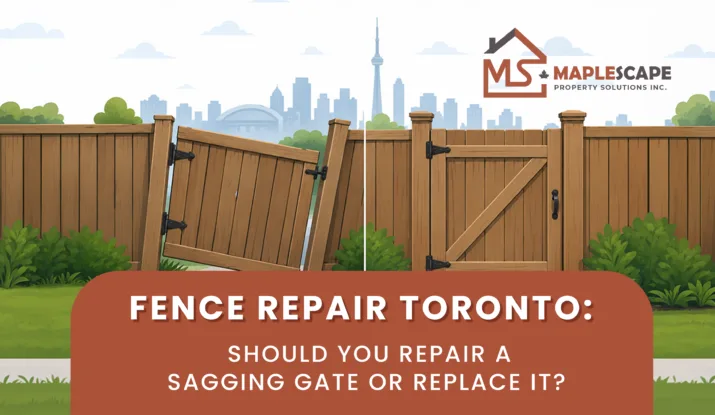
A gate that drags across the ground, refuses to latch or hangs lower on one side can make an otherwise usable fence frustrating to live with. For homeowners considering fence repair Toronto, the important question is not simply whether the gate looks crooked. You need to identify which part has actually failed.
A sagging gate may come from loose hinges, a shifted frame, a leaning post, deteriorated wood or several problems working together. Some issues can be corrected with a focused repair. Others indicate that replacing the gate, supporting post, or adjoining section will be more practical.
1. Why Do Fence Gates Start to Sag?
A gate carries its weight through the hinge side, while the frame needs to remain square enough for the latch side to meet the receiving post correctly. Gate-hardware installation guidance emphasizes accurate hinge positioning, post alignment, spacing, and final gate adjustment for proper operation.
A weak hinge can make the gate drop. A post that leans slightly can pull the opening out of alignment. A loosened frame can sag even when both posts remain vertical. That is why moving the latch first is not always the right repair.
2. Fence Repair Toronto: What Should You Inspect First?
2.1 Check the Hinge Post
Stand back and view the post from more than one direction. If it leans toward the gate or moves when gently pushed, the problem may be below or around the post rather than in the gate itself.
2.2 Check the Hinges and Fasteners
Look for loose screws, bolts, bent hardware, enlarged fixing holes or hinges that no longer sit firmly against the gate and post. Correct hinge placement and secure fixing to both the gate and supporting post are fundamental to gate alignment.
2.3 Check Whether the Gate Frame Is Still Square
Look for joints that have opened and compare the top and bottom edges. If the latch side has dropped while the hinge side remains stable, the frame may have racked out of square.
Minor movement may be correctable; severe distortion can make replacement more practical.
3. Is the Gate Sagging or Is the Fence Post Moving?
If the gate itself has sagged, the posts may remain vertical while the frame drops toward the latch side. If a post has shifted, the entire opening can change shape and affect both clearance and latch alignment.
Signs of a post problem can include:
- a visible lean at the hinge or latch post
- movement at the base
- gaps or disturbed soil around the footing
- connected fence panels becoming misaligned
- repeated gate problems after earlier adjustments
Repairing hinges without stabilizing a moving post may improve the gate temporarily but will not correct the support problem.
4. When Is a Sagging Gate Usually Worth Repairing?
Repair is usually worth considering when the gate materials are still serviceable, and the problem is limited to alignment, hardware or one or two components.
A focused repair may make sense when the hinges are loose, the frame is largely intact, posts remain stable, boards are usable, and the latch only needs minor repositioning after alignment.
The condition of the surrounding fence matters, too. Repairing a sound gate within a stable fence is different from repeatedly repairing one component in a fence that is failing in several places.
5. When Does Gate Replacement Make More Sense?
Replacement becomes more practical when the gate no longer has a sound structure to repair.
5.1 The Frame Is Badly Distorted
If several joints have opened or the frame no longer holds its shape, repeated adjustments may only shift the problem elsewhere.
5.2 The Material Is Deteriorated
Wood that is badly split, soft or unable to hold fasteners securely can limit what a repair can achieve. Hardware needs sound material around its fixing points.
5.3 Several Components Are Failing Together
A gate with damaged hardware, a distorted frame and deteriorated boards may technically be repairable, but replacement may be more practical when little sound material remains.
6. Repair or Replace: A Practical Comparison
| Gate Condition | Repair May Be Practical | Replacement May Be Better |
| Loose hinge | If mounting area is sound | If material cannot hold hardware |
| Minor sag | Often | If frame is badly distorted |
| Gate will not latch | If caused by small alignment change | If posts or frame have failed |
| Damaged boards | If damage is limited | If deterioration is widespread |
| Moving hinge post | Post repair may solve it | If post and gate are both deteriorated |
| Repeated repairs | Reassess the cause | Consider replacement if failures continue |
7. Should You Adjust the Latch to Fix a Sagging Gate?
Moving the latch can solve a minor alignment issue, but it should not hide a larger structural problem.
Check the gate in this order:
- Confirm whether the posts are stable.
- Inspect hinges and fixing points.
- Check the frame for distortion.
- Review bottom and side clearances.
- Adjust the latch after the structure is aligned.
Manufacturer installation guidance also treats gate positioning, hinge alignment, clearances and adjustment as connected parts of proper gate operation rather than independent steps.
If the gate dropped because a hinge is loose, the frame has racked or the supporting post is leaning. Relocating the latch alone leaves the source of movement unchanged.
8. Does Toronto’s Fence Bylaw Matter When Replacing a Gate?
It can. Toronto’s Fence Bylaw regulates fence height, materials and structure, and gates form part of certain fence and enclosure requirements. If replacement changes the gate height, location, or overall design, current requirements should be checked before work proceeds.
Maples Scape currently lists fence and gate repairs within its property maintenance services for Toronto and surrounding GTA communities.
Conclusion
A sagging gate does not automatically require replacement, and a quick hardware adjustment is not always a complete repair. The right decision starts with identifying whether the problem is in the hinges, frame, latch, supporting posts or surrounding fence.
If the structure remains sound, a focused repair can restore alignment and everyday use. When deterioration, distortion, or post movement affects several components, replacement may provide a more practical result.
For homeowners considering fence repair Toronto, inspecting the complete gate opening before choosing a fix can help avoid repeated adjustments and ensure the repair addresses the actual source of the problem.
Frequently Asked Questions
Can you fix a sagging fence gate without replacing it?
Yes, if the posts and gate frame remain sound. Loose hinges, fasteners, small alignment changes, and limited frame movement can often be addressed without replacing the entire gate.
Why does my gate keep sagging after I adjust it?
Repeated sagging may mean the original cause has not been corrected. Check the hinge post, fixing points and frame instead of repeatedly moving the latch.
How do I know if the gate post is the problem?
Look for a visible lean, movement at the base, disturbed soil, or changes in the adjoining fence. A moving hinge post can cause the gate to drop even when the gate itself remains usable.
Should I replace the gate if the wood is damaged?
It depends on how widespread the damage is. One replaceable board is different from a frame or hinge area that can no longer support hardware securely.
Can a new gate be installed on old fence posts?
Only if the existing posts are stable, properly positioned, and capable of supporting the replacement gate. A new gate installed on a weak post can develop the same alignment problem.